

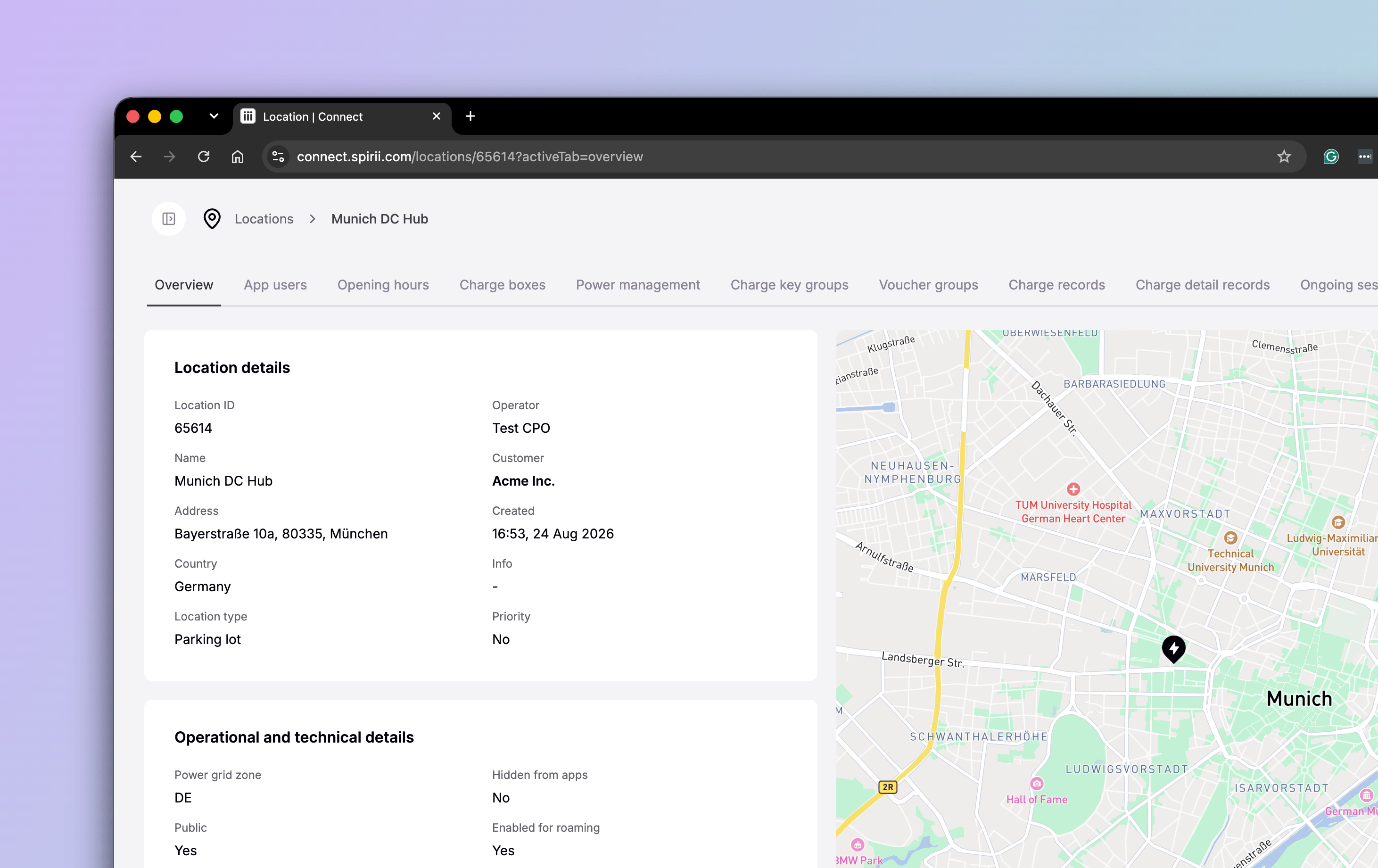
Overview
A location is the top of the charger hierarchy: before a charge box can come online, it has to belong to one. It holds the site’s identity (name, address, geolocation, and type) and anchors the pricing, access, operational, and financial settings that apply to everything installed there. Because so much hangs off it, how you set up a location shapes how every charger on the site behaves.Context
What a location is depends on which side of the platform you work from.CPO context
For a CPO, a location is a site you operate. You create it, set its pricing and access, and bring chargers online under it. The attributes, types, and states below describe a location as Spirii Connect models it for the operator.eMSP context
For an eMSP, a location isn’t something you operate — it’s a node you reach for your drivers, over roaming. You don’t work with the Connect model below. Instead you receive a read-only representation published by the operator, which follows the roaming standard’s (OCPI) conventions rather than Connect’s: the location types, the charger structure, and even the meaning of “published” differ. Roaming covers how that exchange works.Key attributes
Types and states
The types and states below are Spirii’s CPO model in Connect, as introduced under Context; an eMSP reaching the location over roaming sees OCPI’s values instead.Location types
Residential locations aren’t publicly priced, but they’re not tariff-free: a free residential tariff is assigned automatically in the background.
Location states
A location’s state is derived from the chargers installed on it:Relationships
A location sits at the top of the charger hierarchy and anchors four kinds of settings across the site: pricing, access, operations, and financial.The charger hierarchy
Chargers on a location are structured in four levels:- Location: the full site
- Charge box: an individual physical unit
- EVSE: the part of a charge box that can serve one EV at a time; each has its own ID and a status, such as Charging or Available
- Connector: the socket or cable an EV plugs into, with its plug type (e.g. CCS), power type (e.g. DC), and maximum power (e.g. 150 kW)
Used in
Roaming connection
Publish the location to roaming networks and price it for roaming.
EVSEs
The chargers that come online under a location.