

Overview
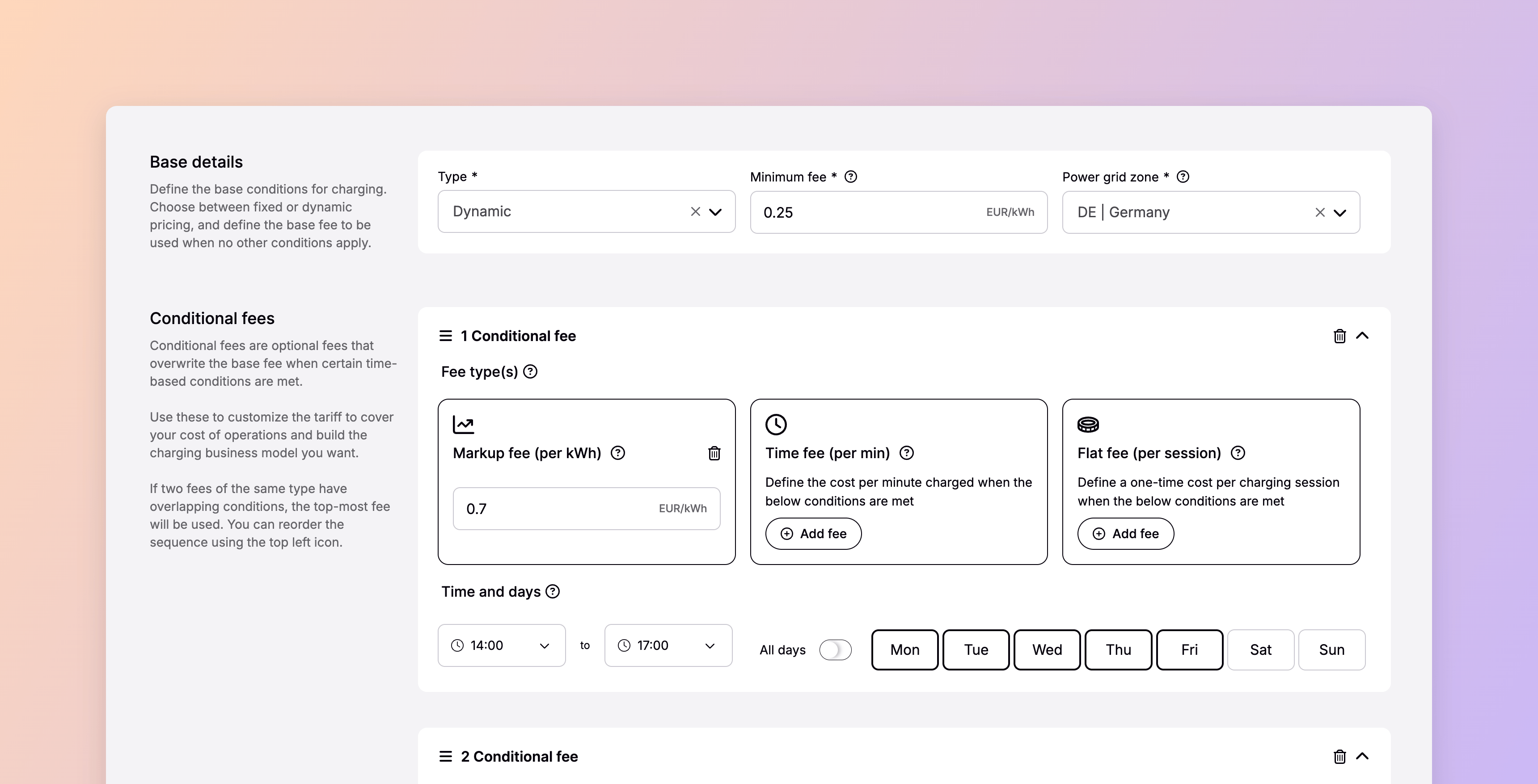
A tariff composes a price from two parts: a base fee that always applies, and optional conditional fees that take over when their conditions are met. You build it once and apply it to as many locations as you like. Separately, you set a roaming tariff: the price external networks are billed when their drivers charge at your locations.Set up
Build tariffs under Tariffs in Spirii Connect: set the name, currency, and base fee, add any conditional fees, then bind the tariff to your locations. Set the roaming tariff separately, on each location. A tariff applies the moment it’s bound; a roaming tariff change applies at the next midnight.How it works
The base fee
Every tariff starts with a base fee, in one of two modes:Fixed
A set price per kWh or per minute that doesn’t change.
Dynamic
The hourly spot price for a power grid zone, with your markup on top.
For dynamic, a minimum fee acts as the floor and the fallback if spot data drops too low or goes missing.
Conditional fees
On top of the base, you can add conditional fees that apply only when their conditions are met:Energy fee
Per kWh. On a dynamic tariff, this is the markup over spot.
Time fee
Per minute, for the duration of the session.
Flat fee
Per session, a one-time charge.
How fees resolve
When fees overlap, two rules keep the price predictable:- Fees are read top to bottom, so their order matters. A fee with a longer delay should sit above one with a shorter delay, since the shorter delay is reached first.
- If two fees of the same type have overlapping conditions, only the top-most applies; a session is never charged twice for the same thing.
Common pricing patterns
A few patterns cover most needs:Day and night pricing
Day and night pricing
Set the base fee to your lowest (night) rate, then add energy fees for the daytime and peak periods using timeslots, mirroring how electricity costs rise and fall through the day.
A blocking fee to free up chargers
A blocking fee to free up chargers
Add a time fee that switches on after, say, 180 minutes, so a driver who’s finished charging is nudged to move on. Limit it to the hours where it matters; the driver is warned in the app before it starts.
A price that scales through the session
A price that scales through the session
Stack time fees with increasing apply-after delays (free for the first hour, a per-minute fee after 60 minutes, and a higher one after 120) to keep a busy site turning over.
A session fee
A session fee
Add a flat fee, at the start or after a delay, where a one-time charge fits the model.
Roaming pricing
The price you set toward external networks is separate from your tariff, and simpler. You set a roaming tariff per location, when editing that location in Connect: a single flat rate per kWh, chosen from a pre-made list rather than built from scratch:- You enter it gross (including VAT for the location’s country) so it’s comparable with your tariff, but eMSPs are billed the net amount. A 1.00 € roaming tariff in a country with 25% VAT reaches the eMSP as 0.80 €.
- Changes take effect at midnight; until then the current roaming tariff stands. Selecting No Roaming turns it off for the location.
- Roaming partners add their own margin on top, so a driver arriving over roaming may see a higher price than your roaming tariff.
Dependencies & limitations
- Tariffs apply within Spirii’s own surfaces. Spirii Go, branded apps, Spirii charge keys, and Spirii POS. External networks receive the roaming tariff instead.
- The roaming tariff is a flat per-kWh price only, billed net to eMSPs, effective at midnight, with partner margin added on top.
Related
Tariffs
The tariff object this builds on.
Roaming connection
How the roaming tariff reaches external networks.
Locations
Tariffs and roaming tariffs are applied per location.
Sessions and CDRs
Where the price a tariff produced is recorded.