

Overview
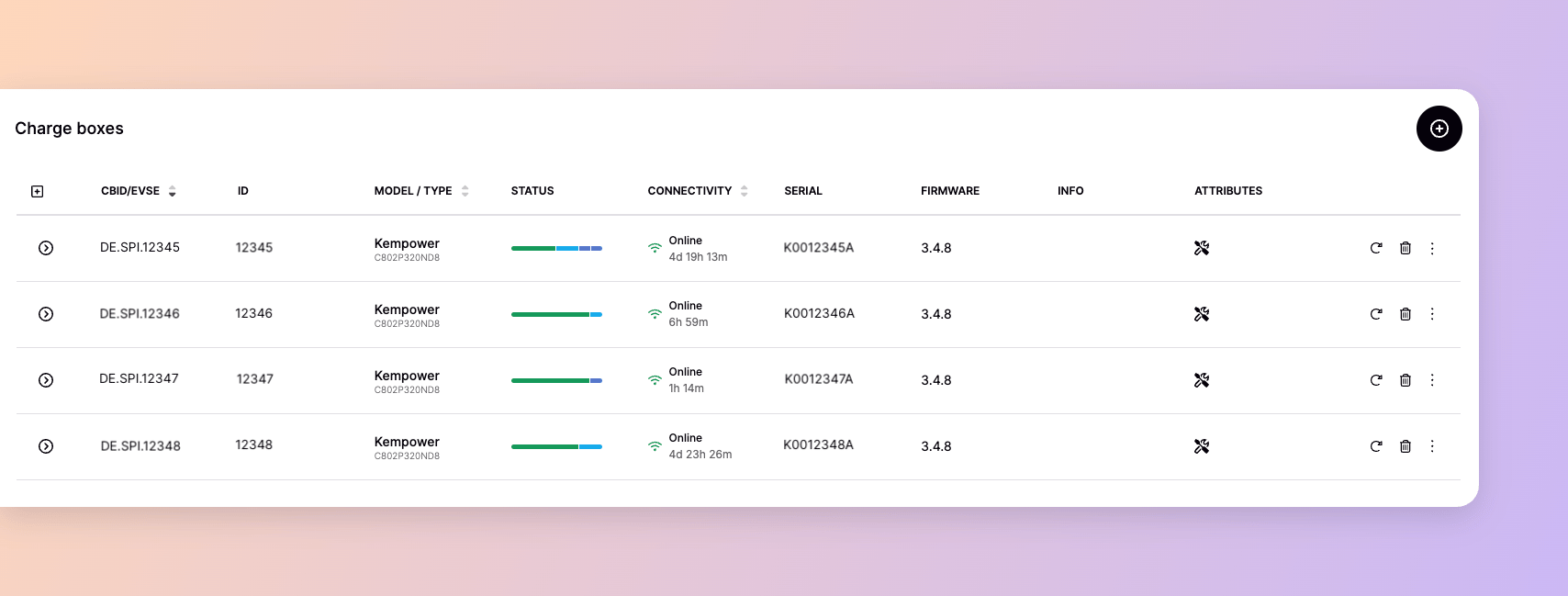
A charge box is the hardware asset in the charger hierarchy: it sits beneath a location and above the EVSEs it contains. When an operator provisions a charger onto a location, the charge box is the object that represents that physical unit in the platform. It holds the settings that belong to the unit as a whole (firmware version, configuration keys, and connectivity) and it records the unit’s logs, such as OCPP message logs and connectivity history. Remote commands that act on the whole unit, like a reboot, are issued at this level. To check which OCPP endpoint a box is currently connected to, open its OCPP configuration in Spirii Connect. For a unit managed through its manufacturer’s own cloud portal, check the endpoint there instead.Context
A charge box is an operator-side object: you manage it in Connect and the Spirii API, and it has no direct equivalent over roaming. The OCPI standard has no charge box layer — it works at the EVSE level and groups EVSEs directly under the location. So a box’s data isn’t lost over roaming, it’s folded into its EVSEs: a box that goes offline surfaces to drivers as an inoperative EVSE, while operator-only details such as firmware stay on the Spirii side.Key attributes
The
ID is the platform’s internal reference; the CBID is what an operator works with, and it seeds the IDs of the EVSEs the box contains.States
A charge box reports its connection status to the platform:
Charging states, such as charging or faulted, are tracked at the EVSE level rather than on the box.
Relationships
A charge box sits in the middle of the charger hierarchy: below the location it belongs to, above the EVSEs it serves. It inherits site-level settings from its location, such as geolocation, access, and pricing, and passes its connection status down to its EVSEs.Used in
EVSEs
The charging units a charge box contains, and where its data surfaces over roaming.
Charge boxes API
Retrieve and manage charge boxes programmatically.