

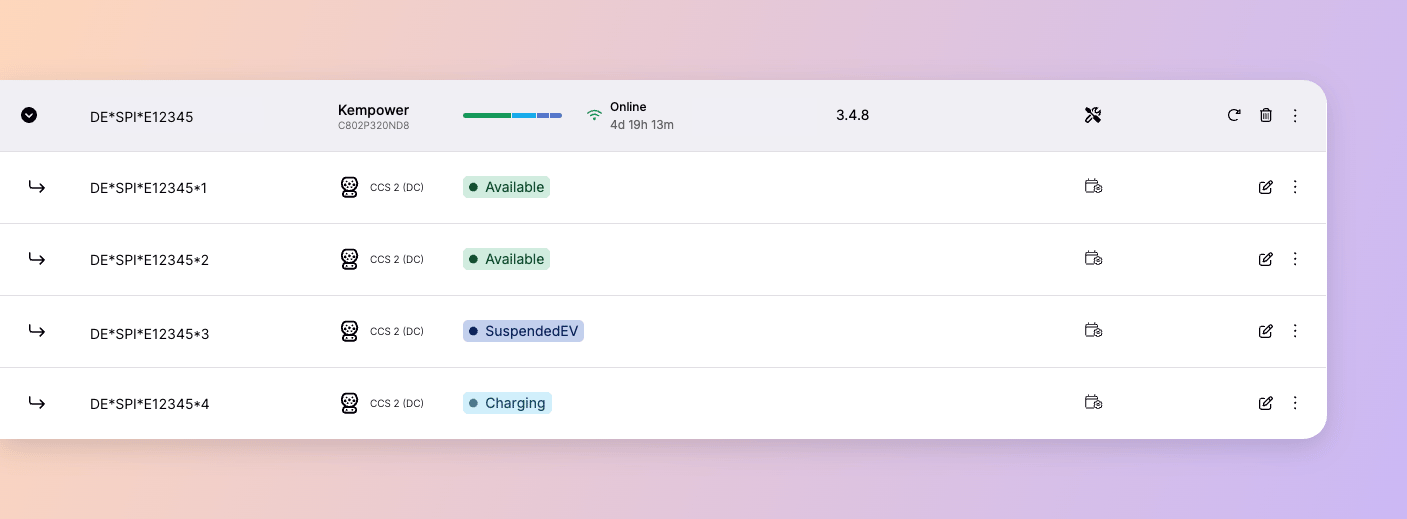
Overview
EVSE stands for Electric Vehicle Supply Equipment: the component of a charge box that supplies a connected vehicle’s battery. It’s both the hardware and the software that manage the charging process — the part of the charger that communicates with the vehicle. A connector is the physical plug a driver attaches to the vehicle. An EVSE usually has a single connector, though it can have more. Spirii models both the EVSE and the connector as levels in the charger hierarchy.Context
An EVSE matters on both sides of a charge — it’s where charging physically happens, and the object roaming is built on.CPO context
For a CPO, the EVSE and its connectors are the charging hardware you model in Spirii Connect: their standard, power, and status. The EVSE ID is derived from the charge box it belongs to. The attributes below describe that model.eMSP context
For an eMSP, the EVSE is the primary object reached over roaming. Across OCPI, the EVSE is what signals operability to other networks, and what each CDR attaches to for settlement. Complete, correctly formatted connector data is what makes a charger usable over roaming, and the charging status maps to OCPI as shown under States.Key attributes
EVSE
The EVSE ID is derived automatically from the charge box’s CBID — you don’t assign it yourself.
Connector
States
An EVSE’s charging status follows OCPP 1.6 and maps to OCPI 2.1.1 for roaming:
Spirii doesn’t use OCPP’s
Reserved status.
Relationships
An EVSE and its connectors sit at the bottom of the charger hierarchy. The EVSE inherits its charge box’s connectivity; box-level commands such asreboot are issued on the charge box and affect the EVSEs it contains.
Used in
Roaming connection
Publish your EVSEs to other networks over OCPI.
Charge boxes
The unit an EVSE belongs to, and where its ID comes from.
EVSEs API
Retrieve EVSE and connector data programmatically.