

Overview
Getting a driver charging at home takes a customer record, a location, an app account, an order, and someone to install the hardware. An onboarding flow produces all of it from one order the customer places themselves. The same flow serves whoever is ordering:A driver buying for their own home
A driver buying for their own home
They order a charge box and a subscription, and arrive with an app account already attached to their address.
An employee ordering through a company scheme
An employee ordering through a company scheme
The employer’s flow presents the products the scheme covers, and the resulting records sit under the employer.
A business ordering for a site
A business ordering for a site
A flow set to business customers collects company details and invoices rather than taking a card.
What a flow creates
A completed order produces the records a charging setup depends on, already bound together.A customer
Assigned to the owner and the agreement you set on the flow.
A location
For the address they gave, residential where the order is for a home.
An app user
Attached to that location, so a driver ordering a home charge box can control it from the app as soon as it is live. For a business ordering chargers for a site, no app user is needed.
An order
Carrying the products they chose, which is what the installation and activation steps work from.
Acme Inc.’s flow therefore becomes a private customer owned by Acme, with a residential location at their own address and an app account attached to it.
The ordering experience
1
Landing page
Optional. A marketing page ahead of the order itself, with your own imagery and sales copy, for flows that need to sell before they collect.
2
Product selection
What a customer can order, usually one item at a time: a charge box model, a charge key, a subscription. Where it helps, several items can be bundled so they present as a single package. For each, you decide whether it is mandatory or an optional add-on, whether its price is shown, and whether a customer can order more than one.
3
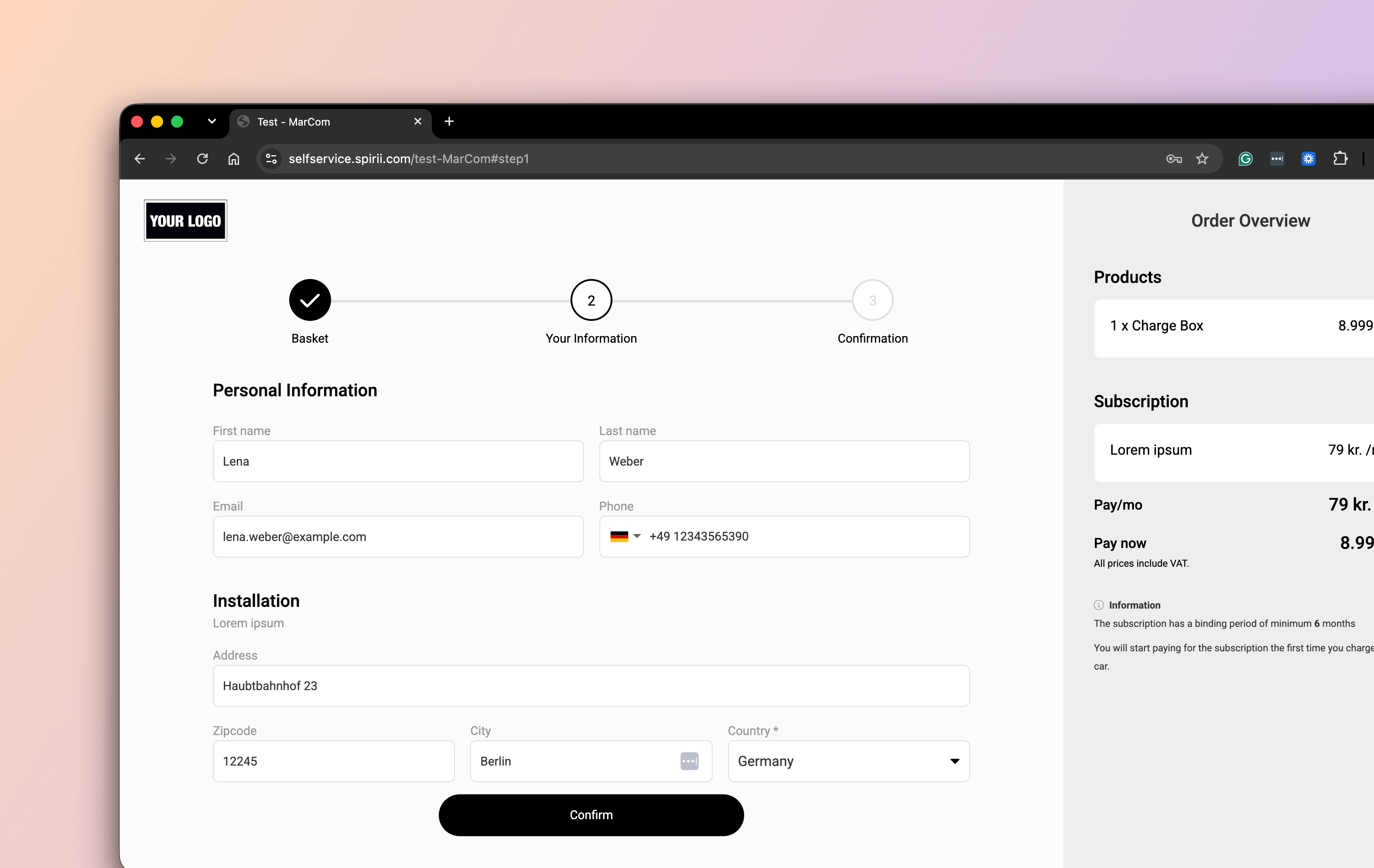
Information
The fields a customer fills in, arranged in groups with their own headings and explanations. You choose each field’s type, label, help text, and whether it is required.
4
Consent
Checkboxes a customer accepts before ordering, each with its own text and links. Some block the order until accepted; others, like a newsletter opt-in, do not.
5
Payment
Card or invoice, set per flow. Card payments are processed through Stripe with Spirii as the merchant, so Spirii’s name appears on the customer’s statement and handles any dispute. On an invoice flow, the customer agrees to be invoiced instead.
6
Confirmation
A success page with your own imagery and welcome text, or a redirect back to your own site.
Flow-level settings
Automated follow-up
A completed order triggers the emails that move the setup along. Each is a template you can write yourself, with its own subject, body, footer, and an optional BCC address for your own records.
Order fulfilment is driven by the charge box activating, so a customer is told their charger is live as soon as it is.
Templates can be written once for a flow, or varied per installation partner where different partners need different instructions. Every email the platform sends is logged, so you can see what a customer received and when.
Installation requests route by postcode. Each installation partner has a contact address and a postcode range per flow, so an order reaches whoever covers that area without anyone forwarding it.
An installation partner receives installation requests only for the postcode ranges assigned to them. A partnership with no range set receives none.
Integration options
You can hand the whole experience to Spirii, keep the storefront and hand over the rest, or build everything and use the platform for what happens after the order.
The hosted flow is the fastest route to live. The API route suits a partner with an existing website and a checkout they already trust, who wants the automation without a second storefront. The middle option sits between them: your storefront, Spirii’s payment page, no card handling on your side.
Set up
Spirii configures onboarding flows as a service, which is how most partners run them. You can also have your own login to the Business Portal, giving you full configuration of your flows and the ability to manage the orders that come through them. Customers themselves are managed in Connect. See Customer management for the hierarchy every flow assigns its sign-ups into. Talk to your account manager to get started.Dependencies & limitations
- Flows are configured in the Business Portal. Onboarding flows are not set up in Connect, although the customers and locations they create appear there.
- Postcode ranges gate installation emails. A partnership without a range sends nothing.
- Spirii is the merchant for card payments. Card orders are processed through Stripe under Spirii, which also covers disputes and refunds for them.
- Payment is card or invoice. Both are set per flow rather than chosen by the customer.
Related
The installation request an order sends is the start of the installer’s side of the process.Installer flow
What happens after an installation request, and what an installer does in Connect.
Customer management
The hierarchy a flow assigns its customers into.
App users
The driver record a flow creates, and how it attaches to a location.
Locations
What a location holds, including the residential ones a flow creates.