

Overview
A voucher bundles three things:A group of drivers
The known audience the voucher is for: a partner fleet, employees, residents, or a pilot group.
The locations they can reach
The sites the voucher opens, including ones that aren’t on the public network.
The price they pay
What charging costs those drivers there, separate from your public pricing.
How it works
Setting up voucher access runs in three steps, all under Vouchers in Spirii Connect:1
Create a voucher group
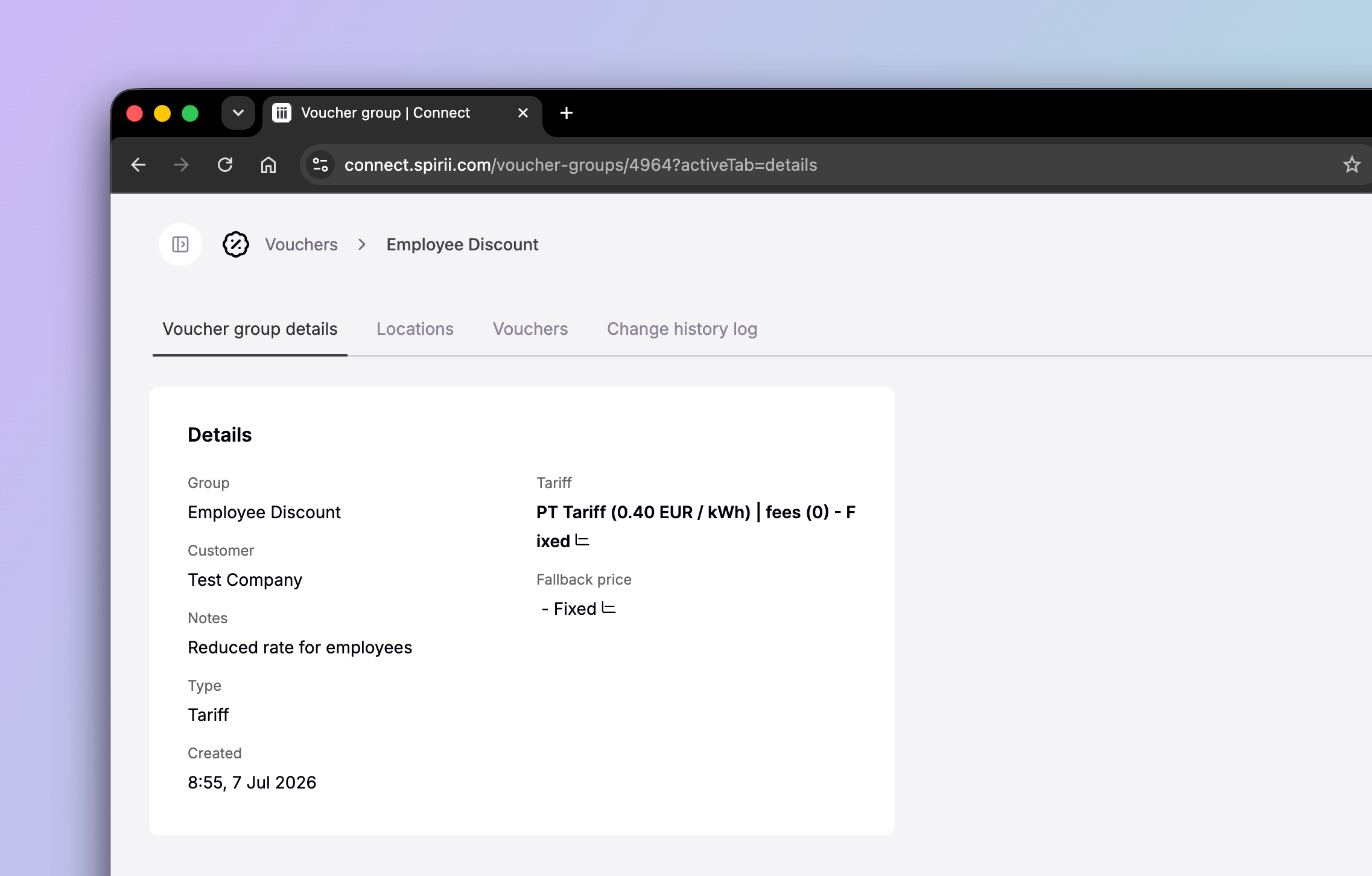
Give it a name, pick the customer, and set the price: link a tariff (recommended) so pricing stays in one place.
2
Attach locations
On the group’s Locations tab, bind the locations the voucher should grant access to. These are where its price applies.
3
Issue codes
On the Voucher tab, add a single code or autogenerate a batch with a shared prefix, each with an optional max-users cap and expiry date.
Options & configuration
Pricing. Set the price with a linked Tariff. That’s the recommended option, so the voucher controls access while the tariff controls price, and your pricing lives in one place. A Fixed price (a flat rate per kWh) or a Dynamic price (spot price plus a markup) can also be set directly on the group, but a linked tariff keeps pricing consistent across the platform. Code restrictions. Use max users to stop a code being shared beyond the intended group, and expires at for time-limited access such as a pilot or a fixed-term agreement. For batches, a clear prefix keeps codes easy to recognise and manage.When to use it
- A partner or guest fleet you want to admit at a negotiated price, without touching your public tariff.
- Employees or residents who should charge at a reduced rate at your sites.
- A pilot or limited-term group, kept tidy with a capped, expiring code.
Charge key association
A voucher can be linked to a charge key as well as redeemed in an app. The link is made on the individual code rather than the voucher group, and it gives that charge key the same terms the group defines: the locations the voucher opens, and what charging costs there. So the same voucher reaches a driver two ways:- Through an app user. The driver enters the code in Spirii Go or a branded app. That attaches their app user to the voucher, up to its max users cap, and applies the access and price to their account.
- Through a charge key. You link the code to a charge key, and any session started with that charge key gets the voucher’s locations and price.
Dependencies & limitations
- Spirii’s mobility surfaces only. Vouchers work in Spirii Go, branded apps, and with Spirii charge keys. They aren’t shared with external eMSPs and don’t travel over roaming.
- A voucher overrides the public tariff. While active, its holder pays the voucher price — not the public price — at every attached location, so be deliberate about who gets a code and where it applies.
Related
Vouchers
The voucher group and code objects this builds on.
Tariffs
Link a tariff to set the voucher price in one place.
Locations
The sites you attach a voucher to.
Charge keys
Link a voucher to a charge key to carry its access.