> ## Documentation Index
> Fetch the complete documentation index at: https://docs.spirii.com/llms.txt
> Use this file to discover all available pages before exploring further.
# Tariffs
> How an operator sets what a driver pays to charge at a location.
A tariff defines what a driver pays to charge at a location: the price, the currency, and the conditions around it.
 ## Overview
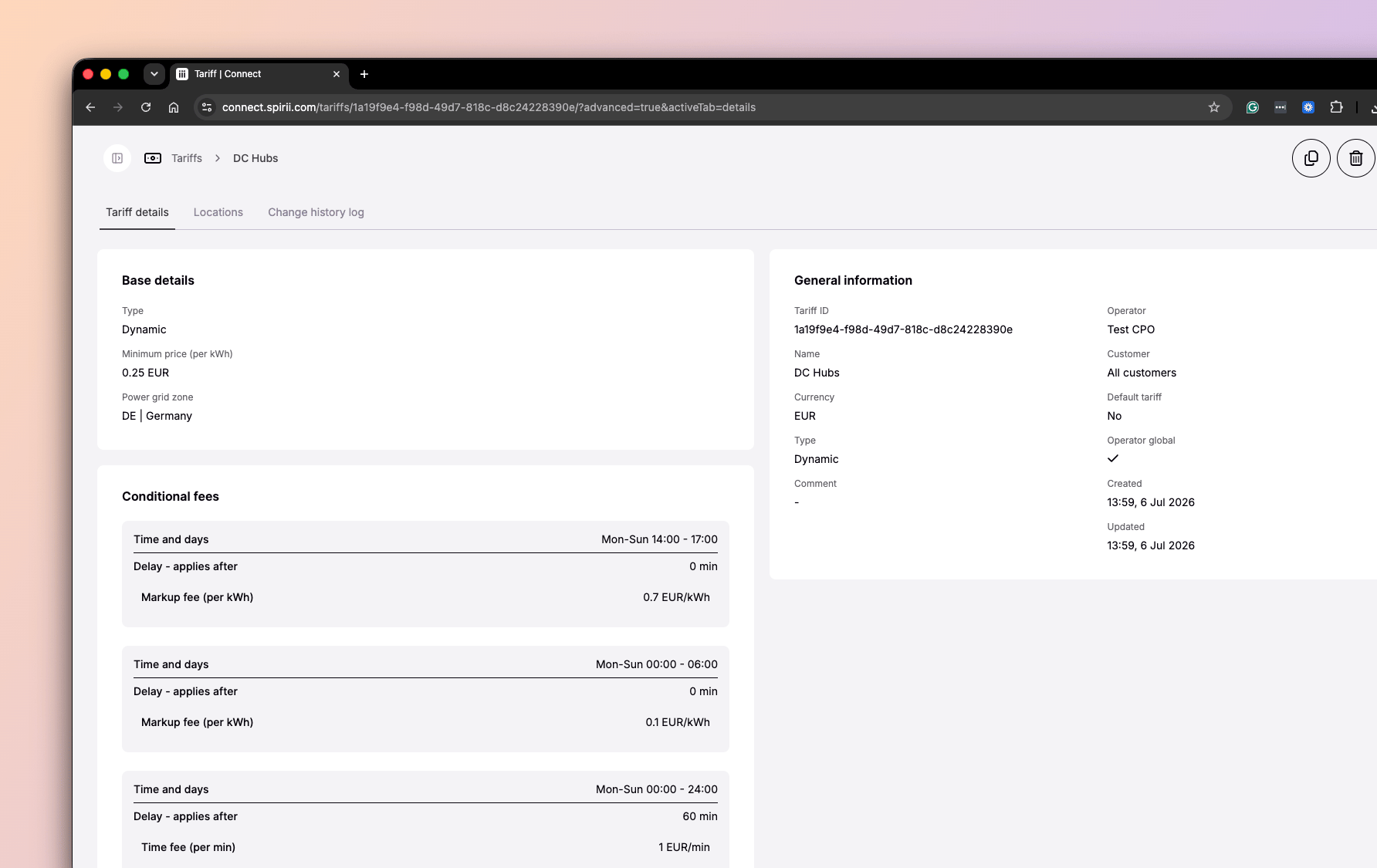
A tariff is the pricing container an operator applies to one or more locations. It sets a base price (a fixed rate, or a dynamic one that follows the hourly spot price) and can layer conditional fees on top to vary the price by time of day, day of week, or how long a session has run. Every price a tariff shows a driver is gross, including VAT.
One tariff can apply to many locations, so a change to it updates the price everywhere it's bound.
## Context
A tariff sits on one side of a two-sided platform, and an operator sets two prices from it: one for Spirii's own surfaces, one for external networks.
### CPO context
You set what drivers pay. Within Spirii's own mobility surfaces — Spirii Go, branded apps, Spirii tokens, and Spirii POS — that's the **tariff**, the full model described below. For drivers arriving from other networks, you set a separate, simpler **roaming tariff**. The attributes here describe the tariff as you build it in Connect.
### eMSP context
An external eMSP never sees your tariff. When its drivers charge at your location over roaming, it's billed your **roaming tariff**: a flat per-kWh price, net of VAT. It then adds its own margin before charging its driver. [Roaming](/capabilities/roaming/roaming-connection) covers how that price is exchanged.
## Key attributes
### Tariff
| Attribute | Description | Example |
| ---------------- | -------------------------------------------------------------------------------------------------------- | ------------------------------------ |
| Name | A clear name for the tariff | `Public DC charging` |
| Currency | The currency the tariff operates in | `EUR` |
| Customer | The customer the tariff belongs to, or All Customers to share it across several | `Acme Inc.` |
| Type | Whether the base price is fixed or dynamic | `Dynamic` |
| Base fee | The fixed price, or (for a dynamic tariff) the minimum fee that applies when spot data is low or missing | `0.45 €/kWh` |
| Conditional fees | Optional fees layered on the base | `Time fee: 0.10 €/min after 180 min` |
A tariff's **base fee** is either **fixed** (a set price per kWh or per minute that doesn't change) or **dynamic** (the hourly spot price from a power grid zone, with a markup on top and a minimum fee as the fallback).
**Conditional fees** layer on top, and each is an **energy fee** (per kWh), a **time fee** (per minute), or a **flat fee** (per session). A fee can be limited to certain times and days, or set to apply only after a session has run for a while. How several fees combine is covered in [Pricing options and logic](/capabilities/pricing/pricing-options-and-logic).
An older tariff format also exists on the platform. It serves a few legacy paths: older app versions, MobilePay in Denmark, and some embedded POS terminals. It doesn't support conditional fees. New tariffs use the format described here.
### Roaming tariff
The roaming tariff is a separate, simpler price: a single flat rate per kWh, set per location, that external eMSPs are billed when their drivers charge there over roaming. You enter it gross (including VAT for the location's country) so it's comparable with your tariff, but eMSPs receive it net.
It's selected from a list per location rather than built like a full tariff. You set it on the location's **Edit location** page in Connect; [Roaming pricing](/capabilities/pricing/pricing-options-and-logic#roaming-pricing) covers how to choose and apply one.
## Relationships
### A tariff is not the final price a roaming driver sees
Within Spirii's surfaces, the tariff is what the driver pays. Over roaming, the roaming tariff is only the price *you* charge the eMSP; the eMSP adds its own margin, so a roaming driver may see a higher price than your roaming tariff.
A voucher can also override a tariff: a driver with an active voucher pays the voucher's price instead, at the locations it covers.
## Used in
How to build a price from a base fee and conditional fees, and set a roaming tariff.
A tariff is applied to one or more locations.
How the roaming tariff reaches external networks.
A voucher can link a tariff, or override one for a user group.
## Overview
A tariff is the pricing container an operator applies to one or more locations. It sets a base price (a fixed rate, or a dynamic one that follows the hourly spot price) and can layer conditional fees on top to vary the price by time of day, day of week, or how long a session has run. Every price a tariff shows a driver is gross, including VAT.
One tariff can apply to many locations, so a change to it updates the price everywhere it's bound.
## Context
A tariff sits on one side of a two-sided platform, and an operator sets two prices from it: one for Spirii's own surfaces, one for external networks.
### CPO context
You set what drivers pay. Within Spirii's own mobility surfaces — Spirii Go, branded apps, Spirii tokens, and Spirii POS — that's the **tariff**, the full model described below. For drivers arriving from other networks, you set a separate, simpler **roaming tariff**. The attributes here describe the tariff as you build it in Connect.
### eMSP context
An external eMSP never sees your tariff. When its drivers charge at your location over roaming, it's billed your **roaming tariff**: a flat per-kWh price, net of VAT. It then adds its own margin before charging its driver. [Roaming](/capabilities/roaming/roaming-connection) covers how that price is exchanged.
## Key attributes
### Tariff
| Attribute | Description | Example |
| ---------------- | -------------------------------------------------------------------------------------------------------- | ------------------------------------ |
| Name | A clear name for the tariff | `Public DC charging` |
| Currency | The currency the tariff operates in | `EUR` |
| Customer | The customer the tariff belongs to, or All Customers to share it across several | `Acme Inc.` |
| Type | Whether the base price is fixed or dynamic | `Dynamic` |
| Base fee | The fixed price, or (for a dynamic tariff) the minimum fee that applies when spot data is low or missing | `0.45 €/kWh` |
| Conditional fees | Optional fees layered on the base | `Time fee: 0.10 €/min after 180 min` |
A tariff's **base fee** is either **fixed** (a set price per kWh or per minute that doesn't change) or **dynamic** (the hourly spot price from a power grid zone, with a markup on top and a minimum fee as the fallback).
**Conditional fees** layer on top, and each is an **energy fee** (per kWh), a **time fee** (per minute), or a **flat fee** (per session). A fee can be limited to certain times and days, or set to apply only after a session has run for a while. How several fees combine is covered in [Pricing options and logic](/capabilities/pricing/pricing-options-and-logic).
An older tariff format also exists on the platform. It serves a few legacy paths: older app versions, MobilePay in Denmark, and some embedded POS terminals. It doesn't support conditional fees. New tariffs use the format described here.
### Roaming tariff
The roaming tariff is a separate, simpler price: a single flat rate per kWh, set per location, that external eMSPs are billed when their drivers charge there over roaming. You enter it gross (including VAT for the location's country) so it's comparable with your tariff, but eMSPs receive it net.
It's selected from a list per location rather than built like a full tariff. You set it on the location's **Edit location** page in Connect; [Roaming pricing](/capabilities/pricing/pricing-options-and-logic#roaming-pricing) covers how to choose and apply one.
## Relationships
### A tariff is not the final price a roaming driver sees
Within Spirii's surfaces, the tariff is what the driver pays. Over roaming, the roaming tariff is only the price *you* charge the eMSP; the eMSP adds its own margin, so a roaming driver may see a higher price than your roaming tariff.
A voucher can also override a tariff: a driver with an active voucher pays the voucher's price instead, at the locations it covers.
## Used in
How to build a price from a base fee and conditional fees, and set a roaming tariff.
A tariff is applied to one or more locations.
How the roaming tariff reaches external networks.
A voucher can link a tariff, or override one for a user group.