> ## Documentation Index
> Fetch the complete documentation index at: https://docs.spirii.com/llms.txt
> Use this file to discover all available pages before exploring further.
# Charge boxes
> Where you manage a charger's firmware, connectivity, and remote commands.
A charge box is the physical unit installed at a site: the cabinet that houses one or more EVSEs.
 ## Overview
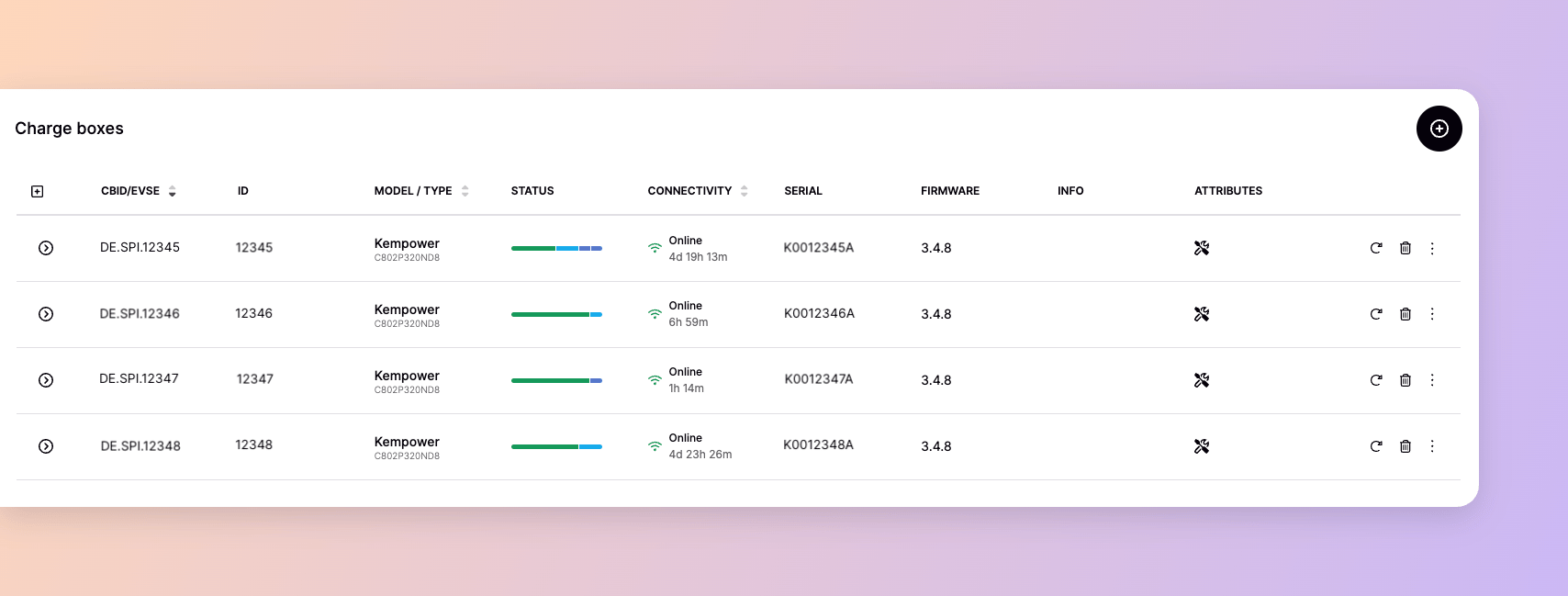
A charge box is the hardware asset in the [charger hierarchy](#relationships): it sits beneath a location and above the EVSEs it contains. When an operator provisions a charger onto a location, the charge box is the object that represents that physical unit in the platform.
It holds the settings that belong to the unit as a whole ([firmware version](/capabilities/operation-monitoring/firmware-management), configuration keys, and connectivity) and it records the [unit's logs](/capabilities/operation-monitoring/charger-history-and-logs), such as OCPP message logs and connectivity history. [Remote commands](/capabilities/operation-monitoring/remote-commands) that act on the whole unit, like a reboot, are issued at this level.
## Context
A charge box is an operator-side object: you manage it in Connect and the Spirii API, and it has no direct equivalent over roaming. The OCPI standard has no charge box layer — it works at the EVSE level and groups EVSEs directly under the location. So a box's data isn't lost over roaming, it's folded into its EVSEs: a box that goes offline surfaces to drivers as an inoperative EVSE, while operator-only details such as firmware stay on the Spirii side.
## Key attributes
| Attribute | Description | Example |
| --------------------- | ------------------------------------------------------------------------------------------------ | ----------------------- |
| ID | Unique identifier for the charge box in the Spirii platform | `12345` |
| Charge box ID (CBID) | The operator-facing identifier; the platform uses it to generate the IDs of the EVSEs on the box | `DE*SPI*E00012345` |
| Vendor | The hardware manufacturer | `Alpitronic GmbH` |
| Model | The specific hardware model | `HYC_400` |
| Firmware | The firmware version currently installed | `hyc_2.4.0` |
| Online | Whether the box is currently connected to the platform | `true` |
| Last connection event | Timestamp of the most recent ping from the box | `14:00:44, 27 Jan 2025` |
The `ID` is the platform's internal reference; the `CBID` is what an operator works with, and it seeds the IDs of the EVSEs the box contains.
## States
A charge box reports its connection status to the platform:
| State | Meaning |
| ------- | --------------------------------------------------------- |
| Online | The box is connected to the platform and ready to charge |
| Offline | The platform hasn't received a ping from the box recently |
Charging states, such as charging or faulted, are tracked at the EVSE level rather than on the box.
## Relationships
A charge box sits in the middle of the charger hierarchy: below the location it belongs to, above the [EVSEs](/components/charging/evses-and-connectors) it serves. It inherits site-level settings from its location, such as geolocation, access, and pricing, and passes its connection status down to its EVSEs.
```mermaid theme={null}
flowchart TD
L("Location") --> CB1("Charge box\nAC")
L --> CB2("Charge box\nDC")
CB1 --> E1("EVSE")
CB2 --> E2("EVSE")
CB2 --> E3("EVSE")
E1 --> C1("Connector\nType 2")
E2 --> C2("Connector\nCCS")
E2 --> C3("Connector\nCHAdeMO")
E3 --> C4("Connector\nCCS")
```
## Used in
The charging units a charge box contains, and where its data surfaces over roaming.
Retrieve and manage charge boxes programmatically.
## Overview
A charge box is the hardware asset in the [charger hierarchy](#relationships): it sits beneath a location and above the EVSEs it contains. When an operator provisions a charger onto a location, the charge box is the object that represents that physical unit in the platform.
It holds the settings that belong to the unit as a whole ([firmware version](/capabilities/operation-monitoring/firmware-management), configuration keys, and connectivity) and it records the [unit's logs](/capabilities/operation-monitoring/charger-history-and-logs), such as OCPP message logs and connectivity history. [Remote commands](/capabilities/operation-monitoring/remote-commands) that act on the whole unit, like a reboot, are issued at this level.
## Context
A charge box is an operator-side object: you manage it in Connect and the Spirii API, and it has no direct equivalent over roaming. The OCPI standard has no charge box layer — it works at the EVSE level and groups EVSEs directly under the location. So a box's data isn't lost over roaming, it's folded into its EVSEs: a box that goes offline surfaces to drivers as an inoperative EVSE, while operator-only details such as firmware stay on the Spirii side.
## Key attributes
| Attribute | Description | Example |
| --------------------- | ------------------------------------------------------------------------------------------------ | ----------------------- |
| ID | Unique identifier for the charge box in the Spirii platform | `12345` |
| Charge box ID (CBID) | The operator-facing identifier; the platform uses it to generate the IDs of the EVSEs on the box | `DE*SPI*E00012345` |
| Vendor | The hardware manufacturer | `Alpitronic GmbH` |
| Model | The specific hardware model | `HYC_400` |
| Firmware | The firmware version currently installed | `hyc_2.4.0` |
| Online | Whether the box is currently connected to the platform | `true` |
| Last connection event | Timestamp of the most recent ping from the box | `14:00:44, 27 Jan 2025` |
The `ID` is the platform's internal reference; the `CBID` is what an operator works with, and it seeds the IDs of the EVSEs the box contains.
## States
A charge box reports its connection status to the platform:
| State | Meaning |
| ------- | --------------------------------------------------------- |
| Online | The box is connected to the platform and ready to charge |
| Offline | The platform hasn't received a ping from the box recently |
Charging states, such as charging or faulted, are tracked at the EVSE level rather than on the box.
## Relationships
A charge box sits in the middle of the charger hierarchy: below the location it belongs to, above the [EVSEs](/components/charging/evses-and-connectors) it serves. It inherits site-level settings from its location, such as geolocation, access, and pricing, and passes its connection status down to its EVSEs.
```mermaid theme={null}
flowchart TD
L("Location") --> CB1("Charge box\nAC")
L --> CB2("Charge box\nDC")
CB1 --> E1("EVSE")
CB2 --> E2("EVSE")
CB2 --> E3("EVSE")
E1 --> C1("Connector\nType 2")
E2 --> C2("Connector\nCCS")
E2 --> C3("Connector\nCHAdeMO")
E3 --> C4("Connector\nCCS")
```
## Used in
The charging units a charge box contains, and where its data surfaces over roaming.
Retrieve and manage charge boxes programmatically.