> ## Documentation Index
> Fetch the complete documentation index at: https://docs.spirii.com/llms.txt
> Use this file to discover all available pages before exploring further.
# Vouchers
> How an operator opens selected locations to a specific group of drivers, at a price they control.
A voucher is a code that gives a chosen group of drivers access to selected locations, at a price you set.
 ## Overview
A voucher does two things at once:
Grants a chosen group of drivers access to a set of locations.
Sets what those drivers pay at the locations it covers.
An operator uses it to open their chargers to a known audience (fleet drivers, employees, residents, VIPs) on terms that don't touch the public price.
A voucher overrides the location's standard tariff. While it's active, the holder pays the voucher price, not the public price, at every location attached to it.
A voucher can also reveal locations that aren't on the public network at all, so it doubles as a way to keep a set of chargers private to the group that holds the code. Treat the access as the primary job and the price as a setting on top: the cleanest setup links the voucher to a tariff for pricing, so the voucher controls *who* and *where*, and the tariff controls *how much*.
## Context
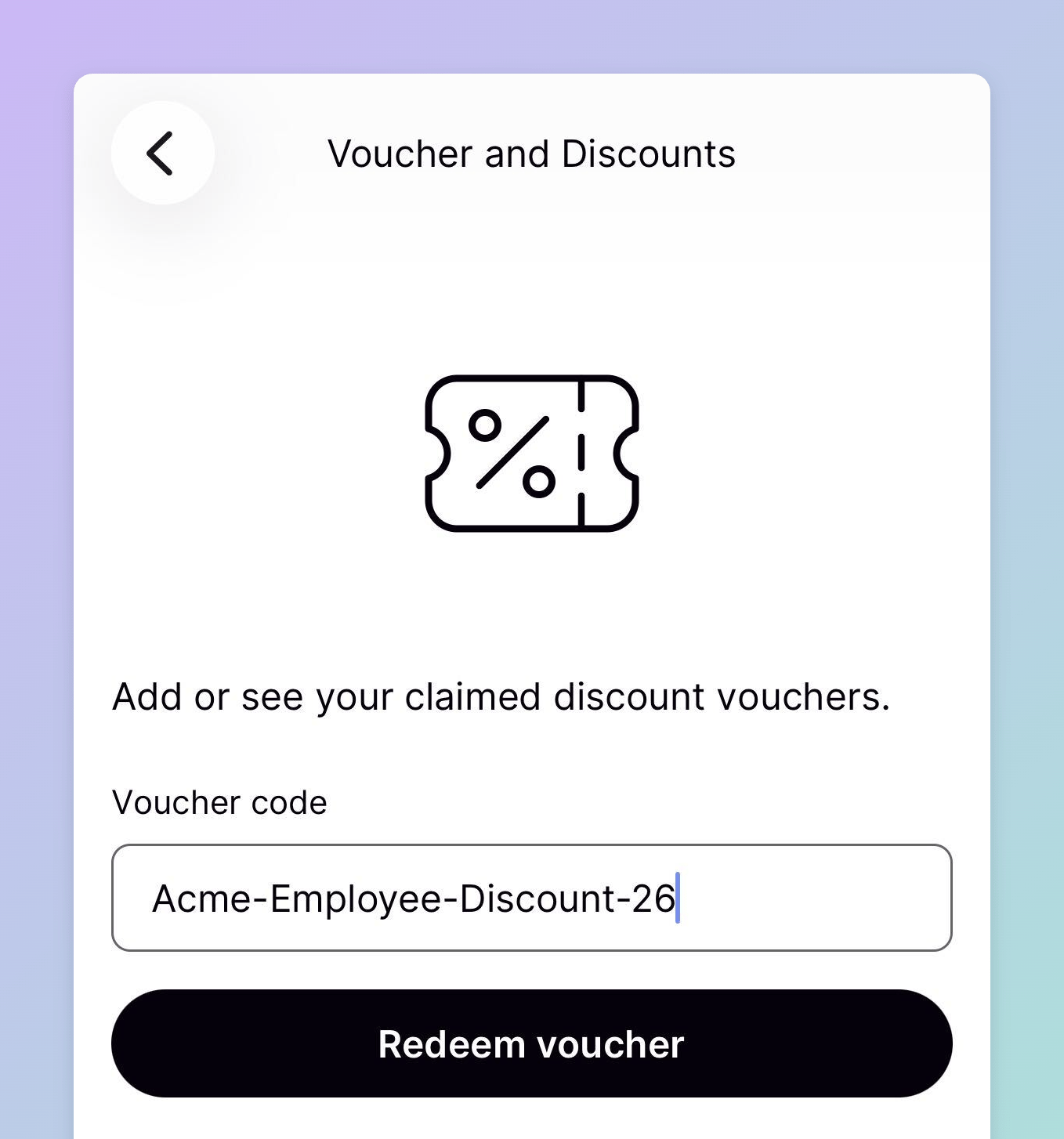
Vouchers are an operator's tool, and they work only within Spirii's own mobility surfaces. A CPO creates and manages them in Connect for their own locations, and a driver redeems a voucher in Spirii Go or a branded app. A voucher can also be linked to a Spirii token, so the token itself carries the access. Vouchers aren't shared with external eMSPs and don't travel over roaming; they grant access on the Spirii network only.
## Key attributes
A voucher has two levels: the **voucher group** that sets the terms, and the **vouchers** — the codes issued under it.
### Voucher group
| Attribute | Description | Example |
| --------- | -------------------------------------------------------------------------------------------------------------------------------------------------- | -------------------------------- |
| Customer | The customer the group belongs to | `Acme Inc.` |
| Name | A clear name for the group, plus an optional internal note | `Acme partner fleet` |
| Price | What voucher users pay at the attached locations. Set it with a linked tariff (recommended); a fixed or dynamic price can also be set on the group | `Partner DC (0,45 €/kWh)` |
| Locations | The locations the voucher grants access to, and where its price applies | `Munich DC Hub`, `Hamburg Depot` |
### Voucher
| Attribute | Description | Example |
| ---------- | ----------------------------------------------------------- | ---------------- |
| Code | The code a driver enters in the app to activate the voucher | `ACME-2026-0042` |
| Max users | Optional cap on how many drivers can use the code | `25` |
| Expires at | Optional date the code stops working | `31 Dec 2026` |
## Relationships
### Vouchers, app users, and tokens
A redeemed voucher doesn't stand on its own; it connects to the things that carry its benefit, and the link between the three is worth getting straight:
* A voucher links directly to the **app users** who redeem its code. Entering the code attaches that app user to the voucher (up to its max-users limit), which is what applies the access and price to their account.
* A voucher can also be linked to a **token**, granting that token the same access and pricing benefits, so a driver charging with the token gets the voucher's locations and price without entering the code in an app.
The same voucher therefore reaches a driver two ways: through the app user who redeemed the code, or through a token it's linked to.
## Used in
Create voucher groups, issue codes, and open locations to a user group.
The price a voucher should link to.
The sites a voucher grants access to.
A voucher can be linked to a token to carry its access.
## Overview
A voucher does two things at once:
Grants a chosen group of drivers access to a set of locations.
Sets what those drivers pay at the locations it covers.
An operator uses it to open their chargers to a known audience (fleet drivers, employees, residents, VIPs) on terms that don't touch the public price.
A voucher overrides the location's standard tariff. While it's active, the holder pays the voucher price, not the public price, at every location attached to it.
A voucher can also reveal locations that aren't on the public network at all, so it doubles as a way to keep a set of chargers private to the group that holds the code. Treat the access as the primary job and the price as a setting on top: the cleanest setup links the voucher to a tariff for pricing, so the voucher controls *who* and *where*, and the tariff controls *how much*.
## Context
Vouchers are an operator's tool, and they work only within Spirii's own mobility surfaces. A CPO creates and manages them in Connect for their own locations, and a driver redeems a voucher in Spirii Go or a branded app. A voucher can also be linked to a Spirii token, so the token itself carries the access. Vouchers aren't shared with external eMSPs and don't travel over roaming; they grant access on the Spirii network only.
## Key attributes
A voucher has two levels: the **voucher group** that sets the terms, and the **vouchers** — the codes issued under it.
### Voucher group
| Attribute | Description | Example |
| --------- | -------------------------------------------------------------------------------------------------------------------------------------------------- | -------------------------------- |
| Customer | The customer the group belongs to | `Acme Inc.` |
| Name | A clear name for the group, plus an optional internal note | `Acme partner fleet` |
| Price | What voucher users pay at the attached locations. Set it with a linked tariff (recommended); a fixed or dynamic price can also be set on the group | `Partner DC (0,45 €/kWh)` |
| Locations | The locations the voucher grants access to, and where its price applies | `Munich DC Hub`, `Hamburg Depot` |
### Voucher
| Attribute | Description | Example |
| ---------- | ----------------------------------------------------------- | ---------------- |
| Code | The code a driver enters in the app to activate the voucher | `ACME-2026-0042` |
| Max users | Optional cap on how many drivers can use the code | `25` |
| Expires at | Optional date the code stops working | `31 Dec 2026` |
## Relationships
### Vouchers, app users, and tokens
A redeemed voucher doesn't stand on its own; it connects to the things that carry its benefit, and the link between the three is worth getting straight:
* A voucher links directly to the **app users** who redeem its code. Entering the code attaches that app user to the voucher (up to its max-users limit), which is what applies the access and price to their account.
* A voucher can also be linked to a **token**, granting that token the same access and pricing benefits, so a driver charging with the token gets the voucher's locations and price without entering the code in an app.
The same voucher therefore reaches a driver two ways: through the app user who redeemed the code, or through a token it's linked to.
## Used in
Create voucher groups, issue codes, and open locations to a user group.
The price a voucher should link to.
The sites a voucher grants access to.
A voucher can be linked to a token to carry its access.