> ## Documentation Index
> Fetch the complete documentation index at: https://docs.spirii.com/llms.txt
> Use this file to discover all available pages before exploring further.
# Live status tracking
> Follow your network as it runs, and support a driver mid-session.
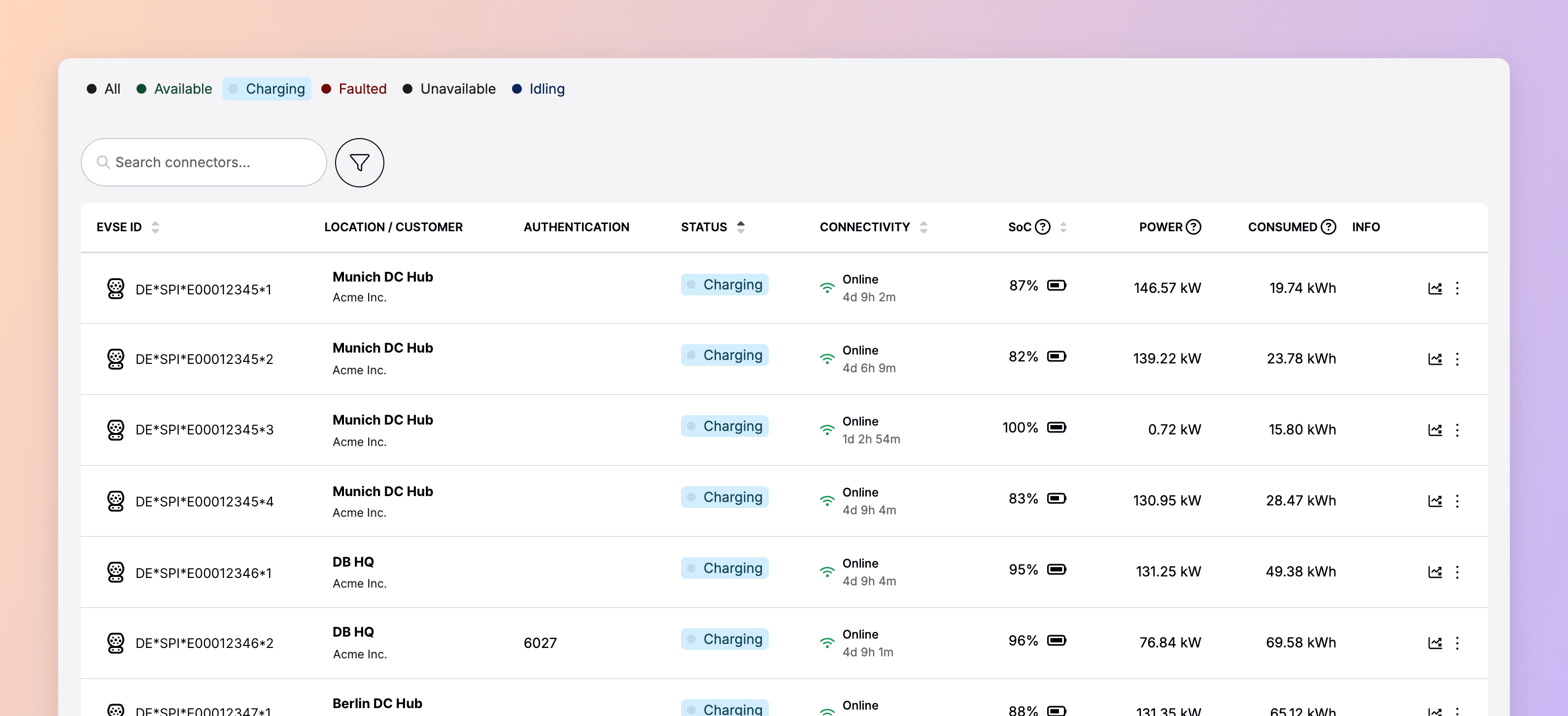
Live status tracking covers two pages in Connect: **Connectors**, which shows what every connector you operate is doing, and **Ongoing sessions**, which shows every charging session in progress.
 ## Overview
The two pages answer different questions from the same underlying data.
Your infrastructure, connector by connector. Status, power, consumption, and who is plugged in.
Every session in progress, on your chargers and on other networks your drivers use.
Reach for **Connectors** when the question is about your infrastructure: how many connectors are charging, which are faulted, where capacity is sitting idle. Reach for **Ongoing sessions** when the question is about one driver and one session, including a session on a network you do not operate.
Connectors also works as a depot view. Filtered to a single location, it is how fleet operators track their own bays: connector 8 sitting at 97% state of charge means a vehicle is ready to leave, while connector 3 delivering unusually low power means a van will not be ready when its driver expects it.
The Connectors page updates as new data arrives from your charge boxes rather than on a fixed refresh, so it tracks close to real time. How current any single reading is still depends on that charge box's own OCPP reporting interval, so two connectors on one page can differ in how fresh their figures are.
An ongoing session is the live half of a session's life. Once it ends it becomes a charge detail record, immutable and ready for billing. See [Sessions and CDRs](/components/charging/sessions-and-cdrs) for how that record is structured.
## Connectors
Connectors lists every connector available to you, including those at locations owned by customers beneath you in the hierarchy. Impersonation works here too, if you want to narrow the view to a single customer's infrastructure.
### What each column shows
| Column | What it tells you |
| ------------------- | --------------------------------------------------------------------- |
| EVSE ID | The connector, with an icon for its type |
| Location / Customer | The site, and the customer that owns it |
| Authentication | What authorised the session, and the token's comment where it has one |
| Connectivity | Whether the connector's charge box is online or offline |
| Status | The connector's current live status |
| SOC | The state of charge of the connected vehicle's battery |
| Power | Power being delivered right now, in kW |
| Consumed | Energy delivered in the current session, in kWh |
| Info | The error code or message the charge box has sent over OCPP |
Read Connectivity and Status together. A faulted connector on an online charge box can tell you what is wrong; when the charge box itself is offline, the status beside it is the last one it managed to send.
The **Authentication** column is the fastest way to tell how a session was authorised:
| What the driver used | What appears |
| ------------------------------------------------------- | ------------------------ |
| Spirii Go or a branded app with a payment method | `SpiriiGo-custId-123456` |
| An RFID token | `DK.SPI.0012345` |
| A virtual token | `DK.SPI.V0012345` |
| An app account with no payment method, charging at home | `Charging at home` |
| No authentication | `NoUID` |
| A Spirii POS payment terminal | `Payment Terminal` |
Where a token carries a comment, it appears alongside the identifier, so a fleet token reads as `DK.SPI.0012345 - Fleet Car #10` rather than as an identifier alone.
### Filtering the list
Status quick-filters sit across the top of the page:
| Filter | What it covers |
| ----------- | ---------------------------------------------------- |
| All | Every connector |
| Available | Ready and unoccupied |
| Charging | Actively delivering |
| Faulted | Reporting a fault |
| Unavailable | Out of service |
| Idling | Preparing, Finishing, SuspendedEV, and SuspendedEVSE |
**Idling** groups four separate OCPP statuses under one filter: a connector plugged in but not yet drawing power, one that has finished and is waiting to be unplugged, and connectors paused by either the vehicle or the charge box. If you are reconciling against raw OCPP data, expect one Idling connector in Connect to be several different things underneath.
Alongside the quick-filters you can filter by location, selecting several at once, and by connector type, one at a time.
### Acting from the list
The menu at the end of each row carries the remote commands for both the charge box and the individual connector, so you can act on what you are looking at without leaving the page.
## Ongoing sessions
Ongoing sessions lists sessions that have started and not yet finished. It splits into two tabs, and which one you want depends on whether you are asking about your chargers or your drivers.
Ongoing sessions does not update on its own. If you are following a session while a driver is on the line, reload the page to see current figures.
### My charging network (CPO)
Sessions running on connectors you operate, whoever started them. This is the same population you would see filtered to Charging on the Connectors page, presented per session rather than per connector.
### My Drivers (eMSP)
Sessions your tokens started, wherever they are charging — including on other operators' chargers over roaming. Each row carries the session ID, the location name and owner, the EVSE ID, the operator and network running the site, the authentication method and identifier, the start time, the EVSE status, and consumption in kWh so far.
That is a narrower set of columns than the network view: no live power, and no state of charge.
### The charging curve
Selecting any session opens a modal with its charging curve and session data, which is how you tell a session that stalled from one that is charging slowly by design. On a session running on another operator's chargers, the curve reflects the data that operator sends, so it may be sparser than one on your own charge box.
### Stopping a session
**Mark as Stopped**, at the end of a session's row, sends a stop command to the charge box. The charge box ends the session, and the platform finalises it, generates the charge detail record, and prices it. Only users with the Operator role can use it.
An eMSP can stop a session on another operator's charger the same way, which is the same action a driver takes from the app.
## A worked example
A fleet van is charging at `Munich DC Hub`, on connector `DE*SPI*E00012345`, authorised with a fleet RFID token.
The operator of the hub follows it on **Connectors**, alongside every other connector across their sites: charge box online, status `Charging`, state of charge at 62%, `47 kW` of power and `18.4 kWh` consumed. Their question is whether the asset is performing as it should.
The fleet operator running the van follows the same session on **Ongoing sessions**, under My Drivers, where it sits among their other vehicles out on the road. Selecting it opens the charging curve, and the question they are answering is a different one: when will this van be ready to move again.
## Dependencies & limitations
* **Freshness follows the charge box.** Connectors updates as data arrives, and each reading is as current as that charge box's OCPP reporting interval allows.
* **Ongoing sessions does not auto-update.** Reload the page to see current figures.
* **SOC needs a DC charge box that receives and forwards it.** State of charge appears only on DC charging, and only where the charge box gets the value from the vehicle and is configured to send it.
* **The driver-side view depends on the operating partner.** A session on another operator's chargers may carry less data, or update less often, than one on your own, and the charging curve reflects whatever that partner sends.
* **Mark as Stopped is operator-only.** Other roles can view sessions but not stop them.
* **Connectors lists what you operate.** A partner with no chargers of their own sees an empty table.
* **Connector type filters one at a time.** Location filtering is multi-select; connector type is not.
## Related
If you are reconciling live figures against billing, start with the completed record rather than the live view.
How a session becomes an immutable, billable record.
The commands available from a connector's row menu.
What appears in the Authentication column, and how comments are set.
How sessions on other operators' networks reach your driver view.
## Overview
The two pages answer different questions from the same underlying data.
Your infrastructure, connector by connector. Status, power, consumption, and who is plugged in.
Every session in progress, on your chargers and on other networks your drivers use.
Reach for **Connectors** when the question is about your infrastructure: how many connectors are charging, which are faulted, where capacity is sitting idle. Reach for **Ongoing sessions** when the question is about one driver and one session, including a session on a network you do not operate.
Connectors also works as a depot view. Filtered to a single location, it is how fleet operators track their own bays: connector 8 sitting at 97% state of charge means a vehicle is ready to leave, while connector 3 delivering unusually low power means a van will not be ready when its driver expects it.
The Connectors page updates as new data arrives from your charge boxes rather than on a fixed refresh, so it tracks close to real time. How current any single reading is still depends on that charge box's own OCPP reporting interval, so two connectors on one page can differ in how fresh their figures are.
An ongoing session is the live half of a session's life. Once it ends it becomes a charge detail record, immutable and ready for billing. See [Sessions and CDRs](/components/charging/sessions-and-cdrs) for how that record is structured.
## Connectors
Connectors lists every connector available to you, including those at locations owned by customers beneath you in the hierarchy. Impersonation works here too, if you want to narrow the view to a single customer's infrastructure.
### What each column shows
| Column | What it tells you |
| ------------------- | --------------------------------------------------------------------- |
| EVSE ID | The connector, with an icon for its type |
| Location / Customer | The site, and the customer that owns it |
| Authentication | What authorised the session, and the token's comment where it has one |
| Connectivity | Whether the connector's charge box is online or offline |
| Status | The connector's current live status |
| SOC | The state of charge of the connected vehicle's battery |
| Power | Power being delivered right now, in kW |
| Consumed | Energy delivered in the current session, in kWh |
| Info | The error code or message the charge box has sent over OCPP |
Read Connectivity and Status together. A faulted connector on an online charge box can tell you what is wrong; when the charge box itself is offline, the status beside it is the last one it managed to send.
The **Authentication** column is the fastest way to tell how a session was authorised:
| What the driver used | What appears |
| ------------------------------------------------------- | ------------------------ |
| Spirii Go or a branded app with a payment method | `SpiriiGo-custId-123456` |
| An RFID token | `DK.SPI.0012345` |
| A virtual token | `DK.SPI.V0012345` |
| An app account with no payment method, charging at home | `Charging at home` |
| No authentication | `NoUID` |
| A Spirii POS payment terminal | `Payment Terminal` |
Where a token carries a comment, it appears alongside the identifier, so a fleet token reads as `DK.SPI.0012345 - Fleet Car #10` rather than as an identifier alone.
### Filtering the list
Status quick-filters sit across the top of the page:
| Filter | What it covers |
| ----------- | ---------------------------------------------------- |
| All | Every connector |
| Available | Ready and unoccupied |
| Charging | Actively delivering |
| Faulted | Reporting a fault |
| Unavailable | Out of service |
| Idling | Preparing, Finishing, SuspendedEV, and SuspendedEVSE |
**Idling** groups four separate OCPP statuses under one filter: a connector plugged in but not yet drawing power, one that has finished and is waiting to be unplugged, and connectors paused by either the vehicle or the charge box. If you are reconciling against raw OCPP data, expect one Idling connector in Connect to be several different things underneath.
Alongside the quick-filters you can filter by location, selecting several at once, and by connector type, one at a time.
### Acting from the list
The menu at the end of each row carries the remote commands for both the charge box and the individual connector, so you can act on what you are looking at without leaving the page.
## Ongoing sessions
Ongoing sessions lists sessions that have started and not yet finished. It splits into two tabs, and which one you want depends on whether you are asking about your chargers or your drivers.
Ongoing sessions does not update on its own. If you are following a session while a driver is on the line, reload the page to see current figures.
### My charging network (CPO)
Sessions running on connectors you operate, whoever started them. This is the same population you would see filtered to Charging on the Connectors page, presented per session rather than per connector.
### My Drivers (eMSP)
Sessions your tokens started, wherever they are charging — including on other operators' chargers over roaming. Each row carries the session ID, the location name and owner, the EVSE ID, the operator and network running the site, the authentication method and identifier, the start time, the EVSE status, and consumption in kWh so far.
That is a narrower set of columns than the network view: no live power, and no state of charge.
### The charging curve
Selecting any session opens a modal with its charging curve and session data, which is how you tell a session that stalled from one that is charging slowly by design. On a session running on another operator's chargers, the curve reflects the data that operator sends, so it may be sparser than one on your own charge box.
### Stopping a session
**Mark as Stopped**, at the end of a session's row, sends a stop command to the charge box. The charge box ends the session, and the platform finalises it, generates the charge detail record, and prices it. Only users with the Operator role can use it.
An eMSP can stop a session on another operator's charger the same way, which is the same action a driver takes from the app.
## A worked example
A fleet van is charging at `Munich DC Hub`, on connector `DE*SPI*E00012345`, authorised with a fleet RFID token.
The operator of the hub follows it on **Connectors**, alongside every other connector across their sites: charge box online, status `Charging`, state of charge at 62%, `47 kW` of power and `18.4 kWh` consumed. Their question is whether the asset is performing as it should.
The fleet operator running the van follows the same session on **Ongoing sessions**, under My Drivers, where it sits among their other vehicles out on the road. Selecting it opens the charging curve, and the question they are answering is a different one: when will this van be ready to move again.
## Dependencies & limitations
* **Freshness follows the charge box.** Connectors updates as data arrives, and each reading is as current as that charge box's OCPP reporting interval allows.
* **Ongoing sessions does not auto-update.** Reload the page to see current figures.
* **SOC needs a DC charge box that receives and forwards it.** State of charge appears only on DC charging, and only where the charge box gets the value from the vehicle and is configured to send it.
* **The driver-side view depends on the operating partner.** A session on another operator's chargers may carry less data, or update less often, than one on your own, and the charging curve reflects whatever that partner sends.
* **Mark as Stopped is operator-only.** Other roles can view sessions but not stop them.
* **Connectors lists what you operate.** A partner with no chargers of their own sees an empty table.
* **Connector type filters one at a time.** Location filtering is multi-select; connector type is not.
## Related
If you are reconciling live figures against billing, start with the completed record rather than the live view.
How a session becomes an immutable, billable record.
The commands available from a connector's row menu.
What appears in the Authentication column, and how comments are set.
How sessions on other operators' networks reach your driver view.