> ## Documentation Index
> Fetch the complete documentation index at: https://docs.spirii.com/llms.txt
> Use this file to discover all available pages before exploring further.
# Faults & Alerts
> Cut the time between a charger failing and you finding out.
The Monitoring list shows every charge box that is offline and every EVSE reporting a fault. Alerts email you when either happens.
## Overview
Charging hardware fails, and the sooner you know the less it costs you. Connect gives you two ways to find out: a list you can work through, and an email for when nobody is looking at the list.
Everything currently offline or faulted, with the error codes the hardware sent and the tools to act on each one.
An email when a charge box goes offline or an EVSE reports a fault, anywhere in your network.
Both reflect what your charge boxes report. Statuses and error codes come from the hardware, so what you see is what the charge box last sent.
## The Monitoring list
Find it in Connect under **Operations → Monitoring**. It lists every charge box currently offline and every EVSE currently in a faulted state, along with the error code and any information message the charge box has sent, and when each was last checked.
### Offline and faulted are different things
Connectivity belongs to the charge box; fault state belongs to the EVSE.
A charge box that has gone offline has stopped talking to the platform, so the last status you have is the last one it managed to send. A faulted EVSE sits on a charge box that is still connected and actively reporting a problem, which is why it can give you an error code and a message.
The list therefore holds two kinds of row, and an offline charge box gives you less to go on than a faulted EVSE does.
### Who sees what
The list respects the customer hierarchy. Impersonation works here, so you can narrow the view to a single customer's sites, and Editors can see the Monitoring list for the locations they have access to.
### Acting on a row
Each row carries the tools for that charge box or EVSE: remote commands, the OCPP logs, its configuration, and its status and connectivity history. The list is where you find the problem; those tools are where you work out what happened and act on it.
## Alerts
Alerts turn the Monitoring list into something that reaches you. Set one up under **Settings → Alerts**: choose the trigger, choose the alert type, give it the email address to notify, and write the subject line you want to see in your inbox.
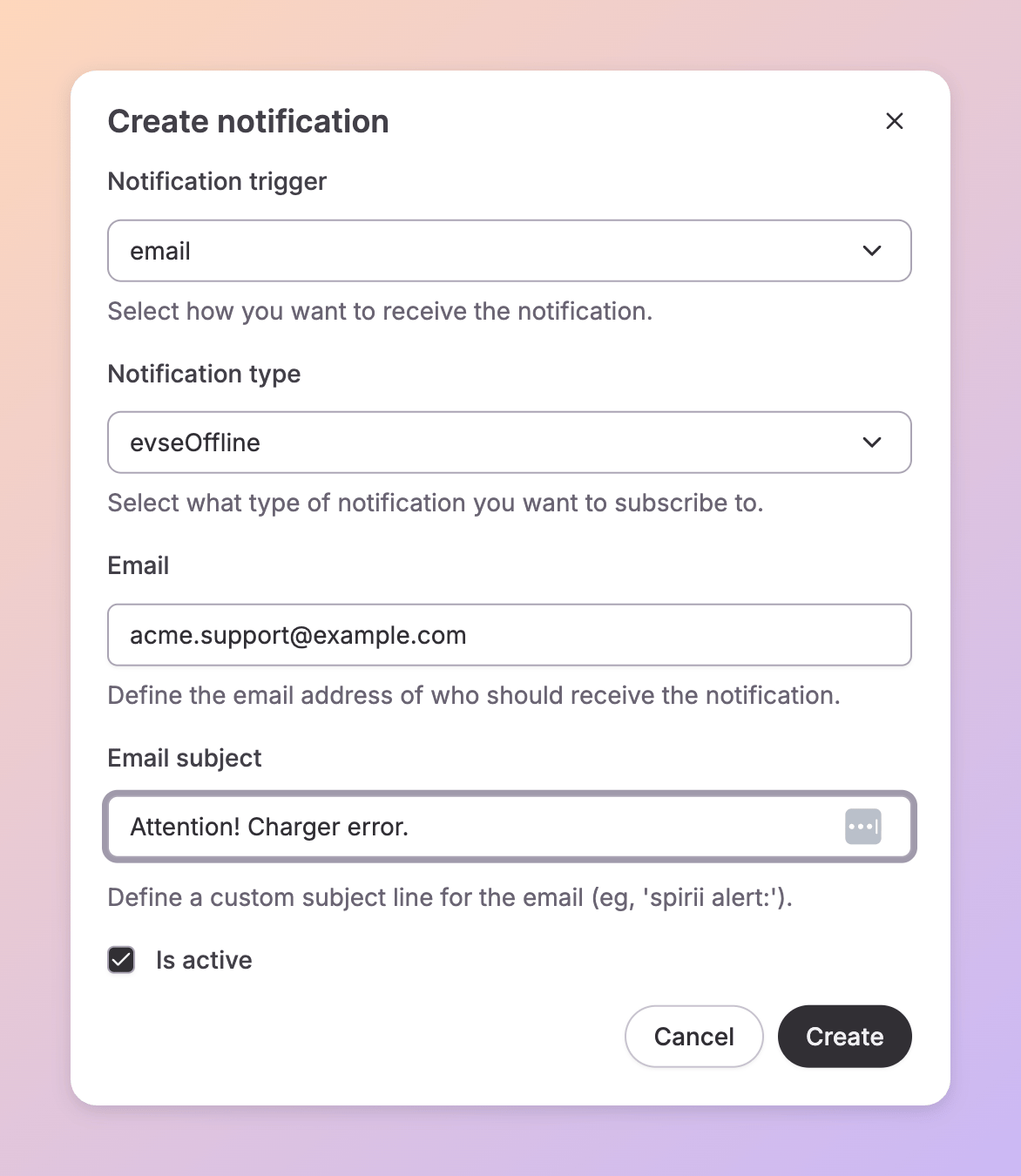 The subject line is the only part of the alert most people read on a phone, so `Charger offline — Munich DC Hub` beats a generic line when three arrive at once. The recipient does not have to be you, so a shared operations inbox works.
### What fires, and when
An alert fires when a charge box goes offline or an EVSE reports a fault, anywhere in your network. There is a delay before it sends, so a charge box that drops and recovers within a few minutes will not generate an email. That keeps a flapping connection from filling your inbox, and it means every alert you receive represents a fault that has persisted.
Alerts tell you when a fault is registered. The Monitoring list is where you see what is currently affected, so a charge box that has recovered drops off it.
## Dependencies & limitations
* **Alerts are network-wide.** An alert covers every charge box and every EVSE under your account.
* **Brief interruptions do not alert.** The delay before sending means a charge box that drops and recovers quickly will not produce an email.
* **The list reflects what the hardware sends.** Statuses, error codes, and information messages come from the charge box. An offline charge box carries no error code, because it stopped reporting.
* **Editors see their own locations.** Impersonation applies, and the list follows the customer hierarchy.
## Related
Once you have found a fault, remote commands are where you act on it.
Resetting, rebooting, unlocking, and the rest of what you can send to a charge box.
The live view across every connector, faulted or not.
What a charge box is, and how it relates to the EVSEs it holds.
Which roles in your organisation can reach the Operations area.
The subject line is the only part of the alert most people read on a phone, so `Charger offline — Munich DC Hub` beats a generic line when three arrive at once. The recipient does not have to be you, so a shared operations inbox works.
### What fires, and when
An alert fires when a charge box goes offline or an EVSE reports a fault, anywhere in your network. There is a delay before it sends, so a charge box that drops and recovers within a few minutes will not generate an email. That keeps a flapping connection from filling your inbox, and it means every alert you receive represents a fault that has persisted.
Alerts tell you when a fault is registered. The Monitoring list is where you see what is currently affected, so a charge box that has recovered drops off it.
## Dependencies & limitations
* **Alerts are network-wide.** An alert covers every charge box and every EVSE under your account.
* **Brief interruptions do not alert.** The delay before sending means a charge box that drops and recovers quickly will not produce an email.
* **The list reflects what the hardware sends.** Statuses, error codes, and information messages come from the charge box. An offline charge box carries no error code, because it stopped reporting.
* **Editors see their own locations.** Impersonation applies, and the list follows the customer hierarchy.
## Related
Once you have found a fault, remote commands are where you act on it.
Resetting, rebooting, unlocking, and the rest of what you can send to a charge box.
The live view across every connector, faulted or not.
What a charge box is, and how it relates to the EVSEs it holds.
Which roles in your organisation can reach the Operations area.