> ## Documentation Index
> Fetch the complete documentation index at: https://docs.spirii.com/llms.txt
> Use this file to discover all available pages before exploring further.
# Energy management
> Distribute, schedule, and control charging power at a site to cut energy costs and protect the electrical infrastructure.
Energy Management is Spirii's portfolio of location-level capabilities for distributing, scheduling, and controlling charging power. Add chargers without expensive grid upgrades, lower energy costs, and protect a site's electrical infrastructure.
## Overview
At a busy site, chargers left to draw power first-come-first-served can overload the circuit's fuse and leave vehicles undercharged. Adding more chargers can mean a costly grid-connection upgrade. Energy Management solves this at the location with four capabilities that share one goal: optimise power distribution, reduce energy costs, and protect the electrical infrastructure.
Distributes available power across chargers within the circuit's fuse limit. The foundation everything else builds on.
Shifts charging to the cheapest hours of a period.
Gives chosen vehicles maximum power ahead of the rest.
Lets external software set charging limits dynamically.
All four work at the location level. Distinct from them is [**Grid Balancing**](/capabilities/energy-management/grid-balancing), which works across your portfolio to *earn* revenue from frequency regulation rather than cutting a single site's costs. The two are not independent, though: grid balancing trims charging power within the boundary Load Balancing sets, and it does so through Programmatic Charger Control — the second logic in the precedence order below.
## How it works
All four capabilities can be active on the same location and circuit at once. When more than one applies, they resolve in a fixed order of precedence:
Always on, to keep the fuse protected.
An external EMS sets the limit. This is also the capability [grid balancing](/capabilities/energy-management/grid-balancing) uses to trim power for frequency regulation.
Critical vehicles get power first.
Charges in the cheapest hours, if nothing above it conflicts.
Fuse protection always comes before optimisation, so DLM wins; price optimisation only acts when nothing above it needs the power.
### Load Balancing (DLM): the foundation
Dynamic load management (DLM) calculates and distributes power from three inputs: the circuit's maximum fuse capacity, each charger's maximum power, and how many vehicles are currently charging. It rebalances automatically whenever a charger's OCPP status changes (for example, when a new vehicle starts charging), so the fuse is always protected and every connected vehicle gets a fair share.
For example, a depot circuit fused at 100 kW feeds four 50 kW chargers. With one vehicle plugged in, it can draw the full 50 kW; with four plugged in, DLM gives each about 25 kW, rather than letting the first two pull 50 kW each and trip the fuse. Without DLM, every charger draws independently up to what its vehicle demands, risking a blown fuse.
Paired with Programmatic Charger Control, the circuit limit itself can flex with local conditions such as solar output or building load. That's advanced dynamic load management (aDLM).
### Price Optimised Charging
A driver plugs in at any time, and the platform schedules charging for the cheapest 15-minute intervals within the period and duration set, starting and stopping the energy flow to match. Without it, a vehicle charges immediately, at whatever the price is at that moment. Drivers can switch this on themselves in Spirii Go.
### Prioritised Charging
When a power limit is active, a vehicle authenticated with a priority token gets the maximum available power first, and whatever remains is shared among the other vehicles. It's built for vehicles that must charge fast regardless of the rest, such as emergency vehicles or critical fleet vehicles.
Prioritised Charging only takes effect when a power-limiting capability (DLM or scheduled charging) is active. With no limit in place, every charger can already deliver full power, so there's nothing to prioritise.
### Programmatic Charger Control
This opens the platform to external software, typically a third-party energy management system (EMS). The EMS reads real-time inputs, sends dynamic power limits to Spirii through the Energy Management API, and the platform adjusts each charger accordingly:
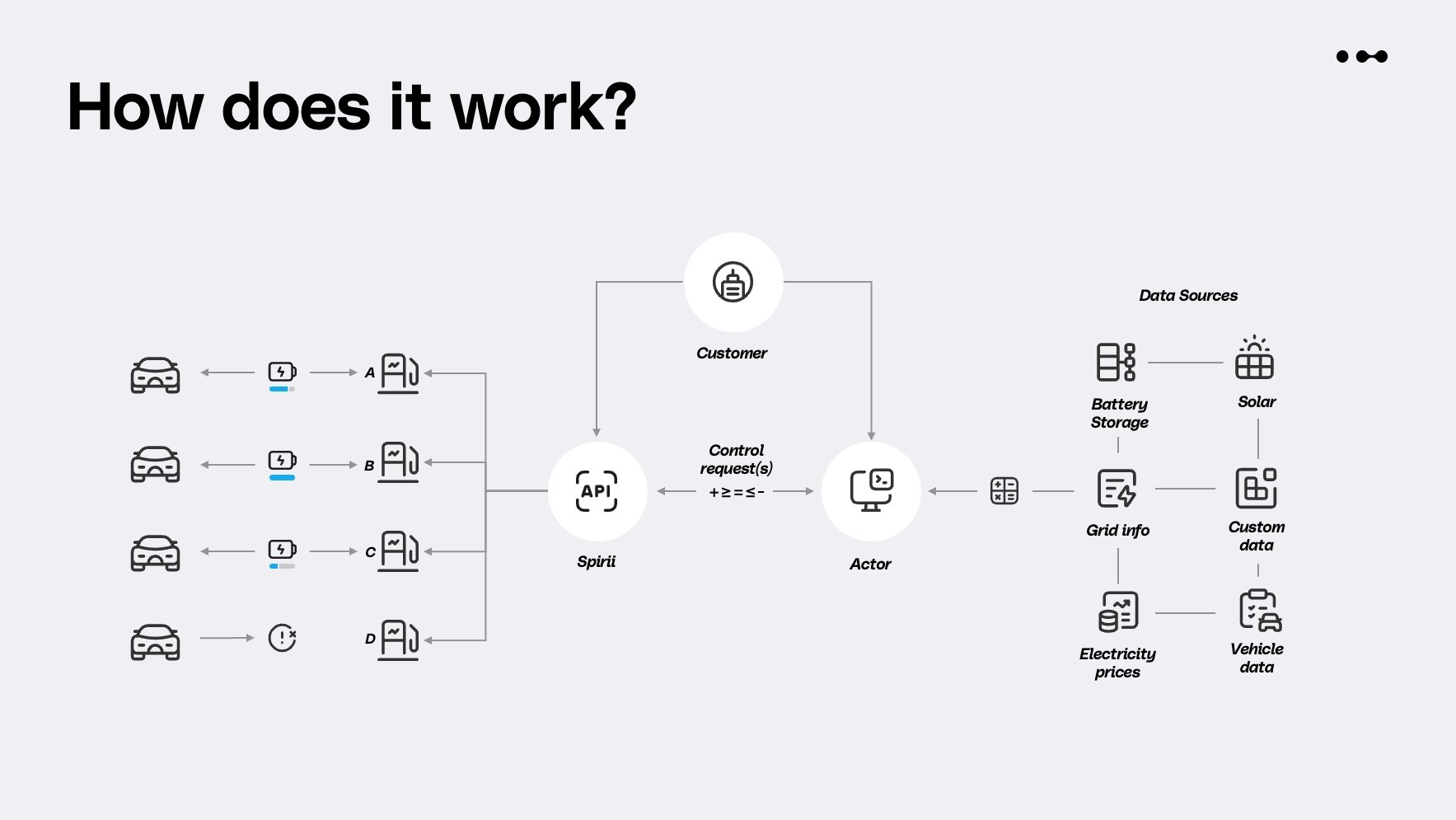 It's what enables solar-optimised charging, battery integration, aDLM, and feeding charger flexibility into grid services.
## Options & configuration
| Capability | What it does | Use it when |
| ---------------------------- | -------------------------------------------------- | ----------------------------------------------------------------------- |
| Load Balancing (DLM) | Shares power across chargers within the fuse limit | Always, since it's the foundation that keeps the site safe and operable |
| Price Optimised Charging | Shifts charging to the cheapest hours of a period | Vehicles stay plugged in longer than they need to charge |
| Prioritised Charging | Gives priority-token vehicles maximum power first | Some vehicles must charge fast regardless of the others |
| Programmatic Charger Control | Lets external software set dynamic power limits | You run an EMS, solar, or battery that should drive charging |
## When to use it
* **A depot with limited grid capacity.** Load Balancing lets you add chargers within the existing connection instead of paying for an upgrade; add Price Optimised Charging so the fleet charges overnight at the cheapest hours.
* **A site with on-site solar and a battery.** Programmatic Charger Control lets your EMS push charging toward solar production and hold the site within its grid-connection limit.
* **A mixed fleet with critical vehicles.** Prioritised Charging keeps the must-run vehicles full while the rest share the remaining power.
## Set up
These capabilities run only on charger models Spirii has validated for them, so that the fuse is never put at risk; Spirii confirms whether your hardware is supported as part of enrolment.
Energy management is enabled on a location by Spirii's Energy Management team. (Driver-facing Price Optimised Charging is the exception: drivers switch it on themselves in Spirii Go.)
## Dependencies & limitations
* **Validated hardware only.** These capabilities run on charger models Spirii has validated for them, which keeps the fuse protected. Check with Spirii whether your model is supported.
* **Programmatic Charger Control needs an external EMS** that you provide; Spirii's platform exposes the charger limits for it to control.
* **Prioritised Charging needs an active power limit** (DLM or scheduled charging) to have any effect, and it works only on the Spirii network, not on roaming.
## Related
Energy management is configured per location, on the circuit its chargers belong to.
The physical units whose power draw energy management balances.
It's what enables solar-optimised charging, battery integration, aDLM, and feeding charger flexibility into grid services.
## Options & configuration
| Capability | What it does | Use it when |
| ---------------------------- | -------------------------------------------------- | ----------------------------------------------------------------------- |
| Load Balancing (DLM) | Shares power across chargers within the fuse limit | Always, since it's the foundation that keeps the site safe and operable |
| Price Optimised Charging | Shifts charging to the cheapest hours of a period | Vehicles stay plugged in longer than they need to charge |
| Prioritised Charging | Gives priority-token vehicles maximum power first | Some vehicles must charge fast regardless of the others |
| Programmatic Charger Control | Lets external software set dynamic power limits | You run an EMS, solar, or battery that should drive charging |
## When to use it
* **A depot with limited grid capacity.** Load Balancing lets you add chargers within the existing connection instead of paying for an upgrade; add Price Optimised Charging so the fleet charges overnight at the cheapest hours.
* **A site with on-site solar and a battery.** Programmatic Charger Control lets your EMS push charging toward solar production and hold the site within its grid-connection limit.
* **A mixed fleet with critical vehicles.** Prioritised Charging keeps the must-run vehicles full while the rest share the remaining power.
## Set up
These capabilities run only on charger models Spirii has validated for them, so that the fuse is never put at risk; Spirii confirms whether your hardware is supported as part of enrolment.
Energy management is enabled on a location by Spirii's Energy Management team. (Driver-facing Price Optimised Charging is the exception: drivers switch it on themselves in Spirii Go.)
## Dependencies & limitations
* **Validated hardware only.** These capabilities run on charger models Spirii has validated for them, which keeps the fuse protected. Check with Spirii whether your model is supported.
* **Programmatic Charger Control needs an external EMS** that you provide; Spirii's platform exposes the charger limits for it to control.
* **Prioritised Charging needs an active power limit** (DLM or scheduled charging) to have any effect, and it works only on the Spirii network, not on roaming.
## Related
Energy management is configured per location, on the circuit its chargers belong to.
The physical units whose power draw energy management balances.