> ## Documentation Index
> Fetch the complete documentation index at: https://docs.spirii.com/llms.txt
> Use this file to discover all available pages before exploring further.
# Location configuration
> How you set up a charging site in Connect — its details, tariff, publishing, and opening hours — before adding chargers.
A location is the container a charging site attaches to: its chargers, tariff, and records all hang off it. Configuring one sets that container up — its details and place on the map, the tariff its chargers bill against, how it's published, and when it's open — so everything you add afterwards has somewhere to live.
 ## Overview
Every charger runs on a location, so a location is the first thing you set up. It holds the site's address and map position, the [tariff](/components/commercial/tariffs) its chargers bill against, its publishing settings, opening hours, and the charge records that come off it. The [Locations component](/components/charging/locations) covers what a location is and how it fits the rest of the platform; this page is how you configure one.
You create and configure locations in Connect under **Locations** with the CPO role, or through the [locations API](/api-reference/locations-v2/creates-a-new-location). The shape is the same either way: set up the location's details, choose how it's published and when it's open, then add chargers. You can also run several locations at one physical site — commonly to split AC and DC chargers, or to give two groups of chargers different pricing or access.
## Setting up the location
Creating a location runs through a single flow in Connect, with the same fields available over the API.
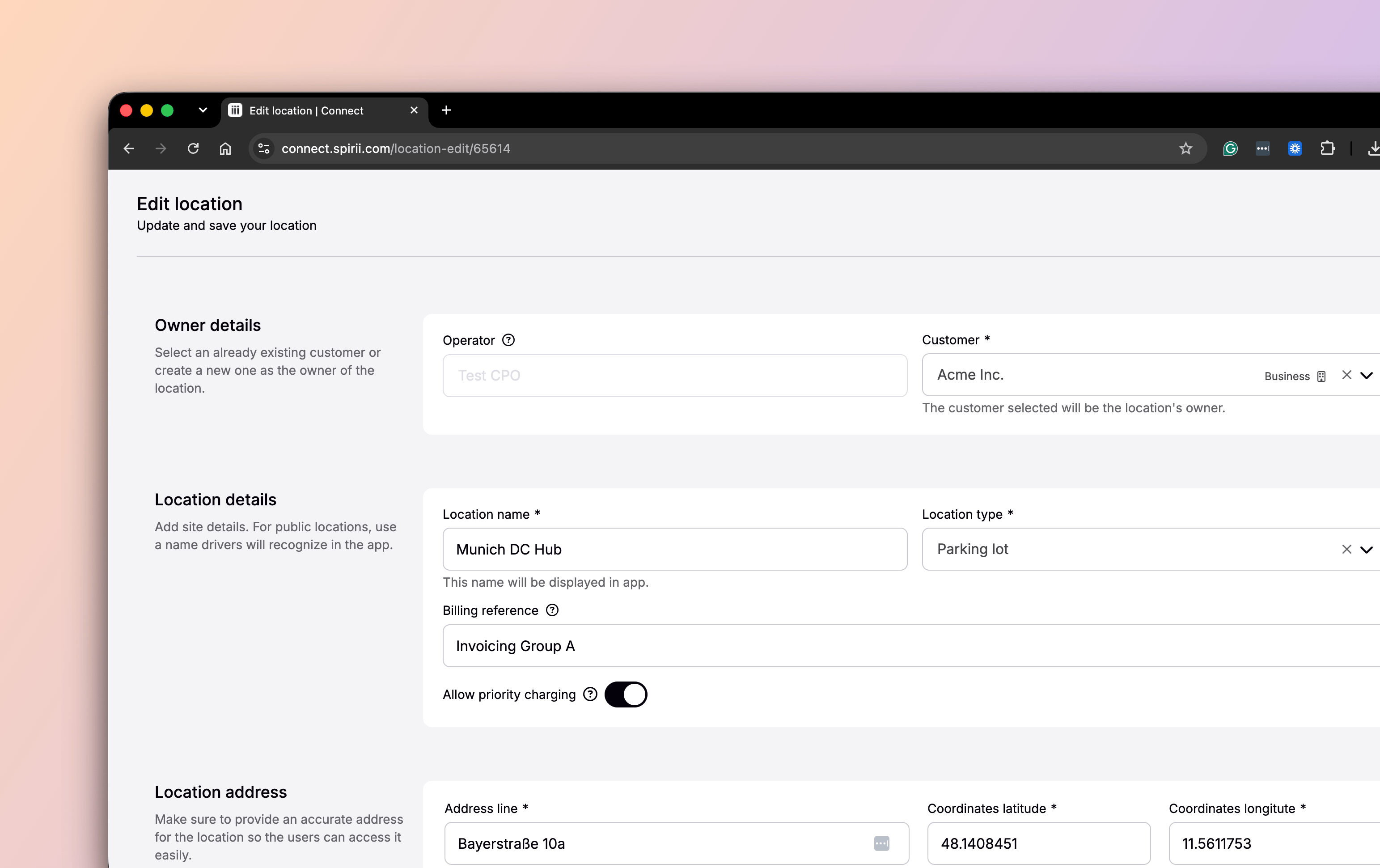
A location belongs to a **customer** — the account it's operated under. Select an existing customer or create one in Connect as you go.
Give the location a **name** drivers will recognise, since it's what shows in charging apps, and pick a **location type** from the list. Parking Lot suits most depots, and Public Road is a common type for public charging hubs. The type is for internal categorisation and isn't shown to drivers. Residential is a special case: it needs no tariff, and lets you choose whether the site owner sees the charger in their app.
Enter the **address**, and the platform places a **map pin** from the derived coordinates. Drag the pin if the chargers sit away from the address entrance, or if two locations share an address and their pins would overlap. Accurate coordinates matter: they're what drivers navigate to, and what roaming networks receive.
Every location needs a **tariff** to be operational — the price its chargers bill against, whether that's 0 EUR for your own fleet or a paid price for third parties. Tariffs are created on the Tariffs page and linked here; if you don't choose one, your operator default applies. See [Pricing options and logic](/capabilities/pricing/pricing-options-and-logic) for how tariffs are built.
Optionally, select the **facilities** available on site, such as rest areas or amenities. These appear in apps and over roaming, helping drivers and fleet planners judge whether a site fits a route. A **financial agreement** can also be attached where one governs the fees and rates for sessions at the location; most own-fleet depots don't need one.
## Publishing settings
You configure publishing on an existing location: open it, select **Edit**, and change these settings there, rather than during the initial creation flow. Three settings control how a location is discovered and reached, and they're independent, so you combine them to fit the site.
* **Publicly available** makes the location visible in charging apps and map services and discoverable by drivers outside your organisation. Leave it off for a site meant only for your own users.
* **Hidden from charging apps** keeps a location usable without listing it in Spirii-managed apps. A driver who arrives with a token that's valid in the Spirii network, or a payment card at a terminal, can still charge; the site is not shown for passive discovery. It's the setting for a site you want reachable but not advertised.
* **Enabled for roaming** lets drivers from other eMSPs charge using their own app or token, billed against a separate roaming tariff. See [Roaming connection](/capabilities/roaming/roaming-connection) for how roaming pricing and settlement work.
A private fleet depot typically stays unpublished; a commercial site is made public, and usually roaming-enabled to lift utilisation. What these settings don't govern is who is *allowed* to charge once they've found the site — that's the job of [Location access](/capabilities/access/location-access).
Making a location public brings regulatory obligations. Public charging in the EU falls under AFIR, the Alternative Fuels Infrastructure Regulation, which sets requirements around price transparency, ad-hoc payment, and consumer information. Responsibility for meeting them stays with you as the site's operator.
## Opening hours
Opening hours set when the site is open to all end-users. By default a location is open around the clock; instead you can define intervals per day, including more than one interval in a day, and drivers see these hours in the apps.
Outside opening hours, the site narrows to your own users: only a driver whose **token or voucher is tied to the location** can charge. So you might open Munich DC Hub to the public from 06:00 to 22:00 and keep it for your own fleet overnight, guaranteeing your drivers a free bay when they need it. How those token and voucher ties work is covered in [Location access](/capabilities/access/location-access).
## Adding chargers
With the location configured, you add chargers to it. Each charge box you connect sits on the location and inherits its tariff and publishing settings. [Charger activation](/capabilities/connection/charger-activation) covers how a charger is provisioned and comes online. While a new charger is being tested and not yet ready for drivers, you can give it a commissioning [temporary EVSE status](/capabilities/operation-monitoring/temporary-evse-status) so it doesn't appear available until you're ready.
## Dependencies & limitations
* **A tariff is required.** A location isn't operational until it has a tariff, even if that tariff is 0 EUR. Residential locations are the exception.
* **Create tariffs first.** Tariffs are made on the Tariffs page, not inside the location flow, so create the one you need before configuring the location.
* **Roaming has data requirements.** A location reaches roaming networks only when it's public, has a roaming tariff, carries accurate coordinates, and uses connector IDs in the required eMI3 format. See [Roaming connection](/capabilities/roaming/roaming-connection).
* **Publishing controls discovery, not permission.** These settings decide who can find and reach a site; who may actually charge is governed in [Location access](/capabilities/access/location-access).
## Related
What a location is, what it contains, and how it connects to the rest of the platform.
How the tariff a location bills against is built.
Publish a location to other networks, and how roaming is priced and settled.
Balance charging power across the chargers on a site.
Who can see and charge at a location, once it's configured.
Provision the chargers that run on the location.
## Overview
Every charger runs on a location, so a location is the first thing you set up. It holds the site's address and map position, the [tariff](/components/commercial/tariffs) its chargers bill against, its publishing settings, opening hours, and the charge records that come off it. The [Locations component](/components/charging/locations) covers what a location is and how it fits the rest of the platform; this page is how you configure one.
You create and configure locations in Connect under **Locations** with the CPO role, or through the [locations API](/api-reference/locations-v2/creates-a-new-location). The shape is the same either way: set up the location's details, choose how it's published and when it's open, then add chargers. You can also run several locations at one physical site — commonly to split AC and DC chargers, or to give two groups of chargers different pricing or access.
## Setting up the location
Creating a location runs through a single flow in Connect, with the same fields available over the API.
A location belongs to a **customer** — the account it's operated under. Select an existing customer or create one in Connect as you go.
Give the location a **name** drivers will recognise, since it's what shows in charging apps, and pick a **location type** from the list. Parking Lot suits most depots, and Public Road is a common type for public charging hubs. The type is for internal categorisation and isn't shown to drivers. Residential is a special case: it needs no tariff, and lets you choose whether the site owner sees the charger in their app.
Enter the **address**, and the platform places a **map pin** from the derived coordinates. Drag the pin if the chargers sit away from the address entrance, or if two locations share an address and their pins would overlap. Accurate coordinates matter: they're what drivers navigate to, and what roaming networks receive.
Every location needs a **tariff** to be operational — the price its chargers bill against, whether that's 0 EUR for your own fleet or a paid price for third parties. Tariffs are created on the Tariffs page and linked here; if you don't choose one, your operator default applies. See [Pricing options and logic](/capabilities/pricing/pricing-options-and-logic) for how tariffs are built.
Optionally, select the **facilities** available on site, such as rest areas or amenities. These appear in apps and over roaming, helping drivers and fleet planners judge whether a site fits a route. A **financial agreement** can also be attached where one governs the fees and rates for sessions at the location; most own-fleet depots don't need one.
## Publishing settings
You configure publishing on an existing location: open it, select **Edit**, and change these settings there, rather than during the initial creation flow. Three settings control how a location is discovered and reached, and they're independent, so you combine them to fit the site.
* **Publicly available** makes the location visible in charging apps and map services and discoverable by drivers outside your organisation. Leave it off for a site meant only for your own users.
* **Hidden from charging apps** keeps a location usable without listing it in Spirii-managed apps. A driver who arrives with a token that's valid in the Spirii network, or a payment card at a terminal, can still charge; the site is not shown for passive discovery. It's the setting for a site you want reachable but not advertised.
* **Enabled for roaming** lets drivers from other eMSPs charge using their own app or token, billed against a separate roaming tariff. See [Roaming connection](/capabilities/roaming/roaming-connection) for how roaming pricing and settlement work.
A private fleet depot typically stays unpublished; a commercial site is made public, and usually roaming-enabled to lift utilisation. What these settings don't govern is who is *allowed* to charge once they've found the site — that's the job of [Location access](/capabilities/access/location-access).
Making a location public brings regulatory obligations. Public charging in the EU falls under AFIR, the Alternative Fuels Infrastructure Regulation, which sets requirements around price transparency, ad-hoc payment, and consumer information. Responsibility for meeting them stays with you as the site's operator.
## Opening hours
Opening hours set when the site is open to all end-users. By default a location is open around the clock; instead you can define intervals per day, including more than one interval in a day, and drivers see these hours in the apps.
Outside opening hours, the site narrows to your own users: only a driver whose **token or voucher is tied to the location** can charge. So you might open Munich DC Hub to the public from 06:00 to 22:00 and keep it for your own fleet overnight, guaranteeing your drivers a free bay when they need it. How those token and voucher ties work is covered in [Location access](/capabilities/access/location-access).
## Adding chargers
With the location configured, you add chargers to it. Each charge box you connect sits on the location and inherits its tariff and publishing settings. [Charger activation](/capabilities/connection/charger-activation) covers how a charger is provisioned and comes online. While a new charger is being tested and not yet ready for drivers, you can give it a commissioning [temporary EVSE status](/capabilities/operation-monitoring/temporary-evse-status) so it doesn't appear available until you're ready.
## Dependencies & limitations
* **A tariff is required.** A location isn't operational until it has a tariff, even if that tariff is 0 EUR. Residential locations are the exception.
* **Create tariffs first.** Tariffs are made on the Tariffs page, not inside the location flow, so create the one you need before configuring the location.
* **Roaming has data requirements.** A location reaches roaming networks only when it's public, has a roaming tariff, carries accurate coordinates, and uses connector IDs in the required eMI3 format. See [Roaming connection](/capabilities/roaming/roaming-connection).
* **Publishing controls discovery, not permission.** These settings decide who can find and reach a site; who may actually charge is governed in [Location access](/capabilities/access/location-access).
## Related
What a location is, what it contains, and how it connects to the rest of the platform.
How the tariff a location bills against is built.
Publish a location to other networks, and how roaming is priced and settled.
Balance charging power across the chargers on a site.
Who can see and charge at a location, once it's configured.
Provision the chargers that run on the location.